
Vietnam Transportation Guide 2026: How to Travel Around Vietnam
Vietnam has a long and narrow geography, stretching more than 1,600 km from the northern mountains to the Mekong Delta in the south. Understanding transportation is therefore one of the most important parts of planning a Vietnam trip. The best way to travel depends heavily on the distance, your budget, the amount of time available and whether you prefer comfort or adventure. For long distances, domestic flights are usually the most practical choice. Trains are slower but offer a scenic way to experience the country, while sleeper buses and limousine vans are useful for shorter regional journeys. Within cities, travelers can use taxis, ride-hailing apps, private cars, buses, motorbikes, bicycles and walking.
Getting Around Vietnam: Which Transportation Should You Choose?
For a first-time visitor, the easiest strategy is to combine several types of transportation rather than rely on one. Use domestic flights for long distances, private cars for regional sightseeing, trains for scenic journeys, buses or limousine vans for shorter transfers, and taxis or ride-hailing services inside cities. This approach saves considerable time while still allowing you to experience different sides of Vietnam.
Vietnam is much larger than it may appear on a map. Traveling from Hanoi to Ho Chi Minh City by train can take around 30–36 hours depending on the service, while traveling between Northern, Central and Southern Vietnam by road can consume an entire day. By comparison, many domestic flights between major cities take only around one to two hours in the air.
Domestic Flights in Vietnam
For most visitors taking a 10-, 14- or 21-day Vietnam itinerary, domestic flights are the most important long-distance transportation option. Flying allows you to spend more time sightseeing instead of sitting on a train or bus for many hours.
The main airports used by international travelers include Noi Bai International Airport in Hanoi, Da Nang International Airport and Tan Son Nhat International Airport in Ho Chi Minh City. Other important tourist airports include Phu Quoc, Cam Ranh, Dong Hoi and Van Don.
Common domestic routes for travelers include Hanoi–Da Nang, Hanoi–Hue, Hanoi–Dong Hoi, Hanoi–Ho Chi Minh City, Da Nang–Ho Chi Minh City, Da Nang–Phu Quoc, Ho Chi Minh City–Phu Quoc and Ho Chi Minh City–Con Dao.
For a classic North-to-South itinerary, flying from Hanoi to Central Vietnam and then from Central Vietnam to Ho Chi Minh City is usually much more efficient than traveling the entire distance overland.
Vietnam Airlines, Vietjet and Other Domestic Airlines
Several airlines operate domestic routes in Vietnam. Vietnam Airlines is the country’s national carrier and has an extensive domestic network. Other airlines such as Vietjet Air offer competitive fares and numerous routes. The best airline for a particular journey depends on departure time, baggage allowance, fare conditions and the price available when you book.
Do not compare domestic flights based only on the headline ticket price. Check baggage allowances, seat selection, airport location, departure time and change or cancellation conditions before booking.
How Early Should You Arrive at a Vietnamese Airport?
For domestic flights, arriving at the airport with sufficient time for check-in, baggage drop, security and boarding is important, especially during weekends, holidays and peak travel periods. Larger airports such as Hanoi and Ho Chi Minh City can be considerably busier than smaller regional airports.
If you have a connecting international flight after a domestic journey, leave a generous buffer. Do not schedule a tight domestic connection immediately before an important international departure because delays can occur.
Traveling by Train in Vietnam
Vietnam’s railway system connects the north and south along a long coastal route. The main railway network stretches approximately 2,600 km and connects Hanoi with Ho Chi Minh City and major destinations in between.
The train is considerably slower than flying, but it offers something planes cannot: the opportunity to see Vietnam’s countryside and coastline from ground level. The route through Central Vietnam can be particularly scenic.
The main railway line connects destinations including Hanoi, Hue, Da Nang, Nha Trang, Phan Thiet and Ho Chi Minh City.
Is the Train Good for Tourists?
The train can be a good choice if you value scenery and the experience of traveling through the country more than speed. It is particularly suitable for travelers who have plenty of time and want to experience a traditional form of Vietnamese transportation.
For a premium itinerary, however, domestic flights are usually more practical for long-distance travel. A 14-day trip should not spend an entire day traveling by train simply to avoid a short flight.
Sleeper Trains in Vietnam
For overnight journeys, travelers can choose sleeper cabins rather than sitting for the entire journey. Four-berth soft sleeper cabins are generally more comfortable for tourists than basic seating.
Private tourist sleeping cars are also available on selected routes, providing a more comfortable alternative for travelers who want the train experience without using the most basic accommodation.
The Reunification Express
The term Reunification Express generally refers to the railway connection between Hanoi and Ho Chi Minh City rather than one single train. The complete journey takes roughly 36 hours, depending on the service and schedule, and passes through several major destinations including Hue, Da Nang, Nha Trang and Phan Thiet.
It is a memorable journey, but it is not the fastest way to travel through Vietnam. If you have only 10 or 14 days, flying is normally a better use of your vacation time.
Vietnam Sleeper Buses
Sleeper buses are one of the most widely used transportation options for budget and mid-range travelers. They are particularly common on routes between Hanoi, Hue, Hoi An, Da Nang, Nha Trang, Da Lat, Mui Ne and Ho Chi Minh City.
Modern sleeper buses usually have reclining or semi-reclining seats designed for long-distance travel. Some routes also operate more comfortable limousine-style buses with fewer passengers and more personal space.
Sleeper buses can be excellent value, but journey times are affected by traffic, road conditions and stops along the way. If you are sensitive to motion sickness or have difficulty sleeping on buses, a domestic flight may be worth the additional cost.
Limousine Vans in Vietnam
Limousine vans have become an increasingly popular option for travelers between nearby destinations. They are especially useful for routes such as Hanoi to Ha Long Bay, Hanoi to Sapa, Hanoi to Pu Luong, Da Nang to Hoi An and Hue to Hoi An.
Compared with conventional buses, limousine vans usually have fewer passengers and more comfortable seats. They can also be convenient for hotel pickup and drop-off, depending on the operator.
For short and medium-distance journeys, a good limousine van can be an excellent compromise between a private car and a standard bus.
Private Car Transportation in Vietnam
For couples, families and travelers looking for comfort, a private car with driver is often the most convenient option for regional travel.
Private cars are particularly useful for Hanoi to Ha Long Bay, Hanoi to Ninh Binh, Hanoi to Pu Luong, Hanoi to Mai Chau, Hanoi to Ha Giang, Hanoi to Sapa, Hue to Hoi An, Da Nang to Hoi An, Hoi An to My Son and Ho Chi Minh City to the Mekong Delta.
The major advantage is flexibility. You can choose the departure time, stop for photographs, take breaks, visit attractions along the route and avoid the fixed schedule of a group bus.
For premium private tours, private transportation is usually preferable to standard public transportation because the vehicle becomes part of the travel experience rather than simply a way of getting from one destination to another.
Taxis in Vietnam
Taxis are widely available in major Vietnamese cities and tourist destinations. They are useful for airport transfers, short journeys and situations where you do not want to use a motorbike.
Use established taxi operators or reputable booking applications. Ask for the meter when using a traditional taxi and check the destination before starting the journey.
Ride-hailing services are also widely used in Vietnam’s major cities.
Grab in Vietnam
Grab is one of the easiest options for visitors who have a smartphone and mobile internet connection. You can generally use it to request a car or motorbike, see the estimated price and follow the driver’s location.
Grab is particularly useful in Hanoi, Ho Chi Minh City, Da Nang and other major urban areas.
Before your trip, make sure your phone has mobile data or arrange an eSIM/SIM card so that you can access transportation applications after landing.
Motorbike Transportation in Vietnam
Motorbikes are one of the most important forms of transportation in Vietnam and are particularly useful for short-distance travel. Vietnam Tourism notes that motorbike rental shops can be found in many cities, with scooter rental prices varying according to the type and quality of the bike.
However, renting a motorbike is not the same as taking a guided motorbike tour. Traffic in major Vietnamese cities can be intense, and road conditions vary considerably between urban areas and mountain regions.
If you are not an experienced motorbike rider, do not rent a motorbike simply because it looks like the cheapest transportation option. A guided motorbike tour with a professional driver can provide the experience without requiring you to manage unfamiliar traffic.
Motorbike Tours in Vietnam
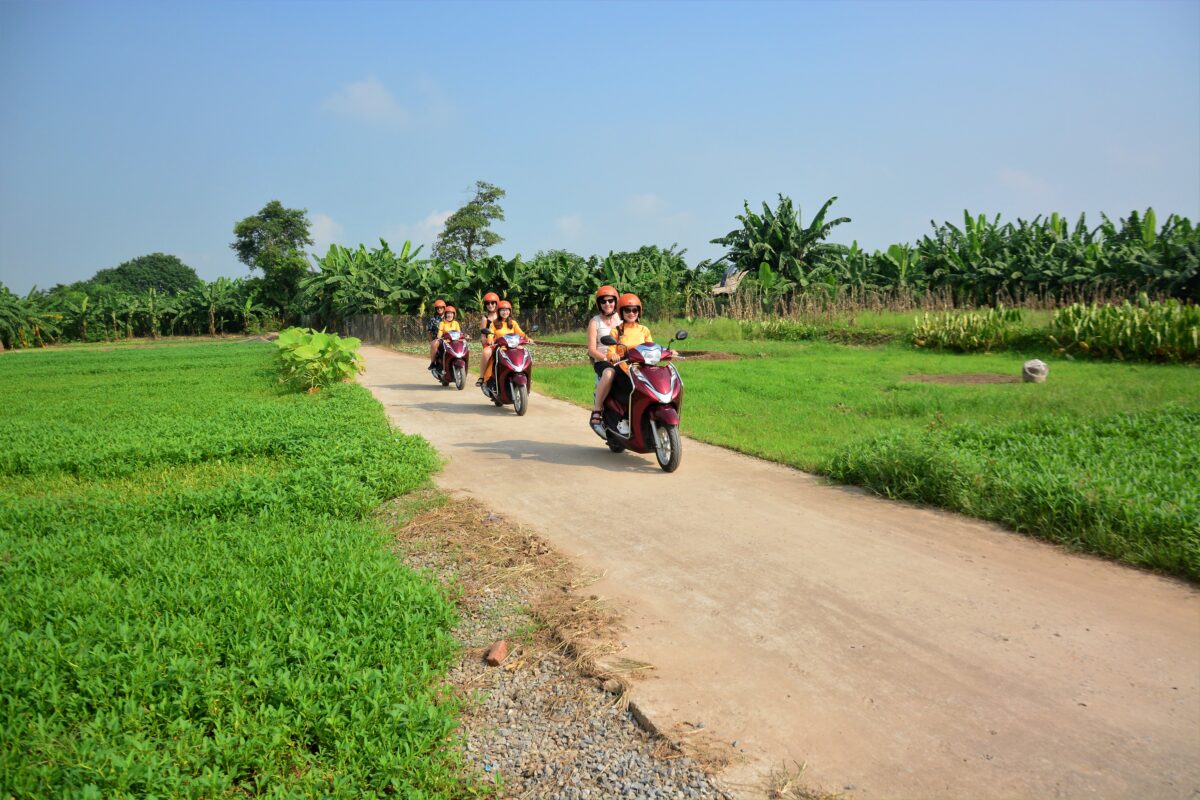
A motorbike tour can be one of the best ways to experience Vietnamese cities because you can move through smaller streets and neighborhoods that are difficult to explore by large vehicle.
In Hanoi, for example, a motorbike tour can combine major attractions with food, residential neighborhoods, markets, lakes, bridges and areas outside the standard tourist route. In Central Vietnam, motorbike experiences can also be used to explore countryside and coastal roads.
For visitors who do not ride motorcycles themselves, riding as a passenger with an experienced driver is an easy alternative.
Is It Safe to Ride a Motorbike in Vietnam?
Motorbike travel requires experience, concentration and appropriate licensing. Always wear a helmet and understand the legal requirements applicable to your license and vehicle.
Traffic in Vietnam may feel chaotic to visitors because motorcycles, cars, buses, bicycles and pedestrians share the same road space. If you are inexperienced, avoid learning to ride for the first time in central Hanoi or Ho Chi Minh City.
For mountain routes such as Ha Giang, road conditions can become more challenging. Travelers should be especially careful with weather, visibility, steep roads and heavy vehicles.
Bicycle Transportation in Vietnam
Cycling is excellent in smaller towns and countryside areas. Hoi An, Hue, the Mekong Delta and some Northern Vietnam destinations are particularly suitable for cycling.
Cycling gives you access to small roads, rice fields, villages and countryside scenery that may be difficult to appreciate from a large vehicle.
Vietnam Tourism notes that cycling is especially attractive in smaller towns and beach destinations, with Hoi An and Hue among the places where bicycles can be practical for getting around.
Walking in Vietnam
Walking is one of the best ways to explore historic areas such as Hanoi’s Old Quarter, Hoi An Ancient Town and central Hue. It allows you to stop at cafés, food stalls, shops and small streets without worrying about parking.
However, Vietnam’s tropical climate means that walking can become uncomfortable during the hottest part of the day. Start sightseeing early and take breaks during the afternoon, especially during the warmer months.
Electric Vehicles and E-Scooters
Electric vehicles are becoming increasingly visible in Vietnam, particularly in tourist areas and urban environments. They can be useful for short-distance transportation and sightseeing.
However, the availability of electric rental vehicles varies by destination. Do not assume that you will be able to rent the same type of vehicle in every city.
Transportation in Hanoi
Hanoi’s Old Quarter is compact enough to explore on foot, but taxis, ride-hailing cars, motorbikes and guided tours are useful when traveling farther.
For airport transfers, a pre-arranged private car is the easiest option if you have luggage or arrive late at night. During sightseeing, walking can be combined with taxis or a guided motorbike experience.
For visitors staying outside the Old Quarter, transportation planning becomes more important because attractions can be spread across different parts of the city.
Transportation in Ha Long Bay
Ha Long Bay itself is primarily explored by cruise boat, but reaching the port is normally done by road from Hanoi or another northern destination.
A private car or high-quality transfer can be more comfortable than a shared bus, particularly for families and travelers with large luggage. Once you board the cruise, transportation around the bay becomes part of the experience.
Transportation in Sapa
Sapa is commonly reached by road from Hanoi using sleeper buses, limousine vans or private cars. Travelers can also use the railway to Lao Cai and continue by road to Sapa.
Once in Sapa, walking and trekking are important forms of transportation around the town and surrounding mountain areas. Private cars or organized transfers are useful for reaching more distant villages and viewpoints.
Transportation in Ha Giang
Ha Giang is primarily a road-trip destination. Travelers can reach the region from Hanoi by bus, limousine vehicle or private car and then continue around the mountains by motorbike, Easy Rider or private vehicle.
Because the scenery is spread across large distances and mountain roads can be demanding, transportation should be planned carefully. Travelers should avoid treating the Ha Giang Loop as an ordinary city-to-city transfer.
Transportation in Hue
Hue is relatively easy to explore by private car, taxi, motorbike or bicycle. The Imperial City is close to the center, while the royal tombs are spread along the outskirts.
A private car is particularly useful if you want to visit several tombs in one day because it avoids repeatedly arranging transportation between sites.
Transportation in Da Nang
Da Nang is one of the easier Vietnamese cities for transportation. The airport is close to the city, taxis and ride-hailing services are widely available, and private cars are useful for trips to Hoi An, Ba Na Hills, Marble Mountains and Son Tra Peninsula.
Transportation Between Da Nang and Hoi An
The distance between Da Nang and Hoi An makes this one of the easiest Central Vietnam transfers. Travelers can use a taxi, Grab, private car, shuttle or organized tour.
A private car is particularly useful if you want to stop at Marble Mountains or other attractions along the way rather than traveling directly between the two cities.
Transportation in Hoi An
Hoi An Ancient Town is best explored on foot, while bicycles are excellent for reaching the countryside, rice fields and nearby villages. Motorbikes, taxis and private cars are useful for destinations farther away.
For many visitors, the best combination is walking in the Ancient Town and cycling or using a private vehicle outside the historic center.
Transportation in Phong Nha
Phong Nha can be reached by flight to Dong Hoi followed by road transfer, or by train or bus. From Dong Hoi, the road journey to Phong Nha is generally the final part of the transfer.
Once there, visitors can use private cars, motorbikes, bicycles and boats depending on the attraction. The Phong Nha area itself is particularly suitable for combining road transportation with boat travel to caves.
Transportation in Ho Chi Minh City
Ho Chi Minh City has a large network of taxis, ride-hailing cars and motorbikes. Walking works well in the central tourist areas, but the city is large enough that you will normally need another form of transportation for attractions farther apart.
Grab is particularly useful for short journeys, while private cars are better for airport transfers, families and full-day sightseeing.
Transportation in the Mekong Delta
The Mekong Delta is different from most other regions because boats are part of the transportation system and the travel experience. Depending on the itinerary, you may use private cars, small boats, sampans, ferries, bicycles and larger river boats.
For a comfortable Mekong Delta experience, private transportation combined with a private boat is often much more flexible than joining a large group tour.
Transportation in Phu Quoc
Phu Quoc is relatively large, so transportation matters when planning your accommodation. Taxis, private cars, motorbikes and organized transfers are commonly used.
If you are staying at a resort and mainly want beach time, you may not need transportation every day. If you want to explore the island, visit different beaches, fishing communities and attractions, arranging a vehicle or renting a motorbike can be more convenient.
Transportation in Con Dao
Con Dao is much smaller and quieter than Phu Quoc. Motorbikes are commonly used by visitors who want to explore independently, while taxis and private vehicles are useful for travelers who prefer not to ride.
Boat transportation becomes important for island excursions, snorkeling and marine experiences.
Vietnam Airport Transfers
Airport transfers are one of the easiest parts of a Vietnam trip to arrange in advance. A private airport pickup is particularly worthwhile when arriving after a long international flight, traveling with children or carrying multiple pieces of luggage.
The major advantage is that the driver is waiting for you rather than requiring you to negotiate transportation immediately after landing.
Vietnam Transportation for Families
Families should prioritize reliable transfers and avoid unnecessary changes. Private cars are usually the easiest option for journeys between nearby destinations because parents can control departure times, stop for food and manage luggage.
For long distances, domestic flights save valuable vacation time. For shorter journeys, private cars or limousine vans are usually more comfortable than standard sleeper buses.
Vietnam Transportation for Couples
Couples have more flexibility and can choose transportation according to the style of their trip. Private cars provide comfort and privacy, while trains can add a scenic travel experience.
For a luxury itinerary, the most efficient combination is usually domestic flights + private cars + premium cruise + occasional boat or cycling experiences.
Vietnam Transportation for Solo Travelers
Solo travelers have the widest range of transportation options. Domestic flights are convenient for long distances, sleeper buses can reduce accommodation costs, and trains provide opportunities to meet other travelers.
Motorbike tours are also a popular way to experience Vietnamese cities without needing to ride independently. Vietnam Tourism specifically recommends domestic flights for convenience while also highlighting trains, sleeper buses, limousine vans, boats and motorbikes as alternatives.
Vietnam Transportation for Luxury Travelers
For premium travel, transportation should be treated as part of the overall experience. The most practical structure is private airport transfers, domestic flights for long distances, private cars between nearby destinations, premium cruises and private boats where appropriate.
This approach eliminates unnecessary waiting, reduces hotel-to-hotel transfer time and allows the itinerary to remain flexible.
How Much Does Transportation Cost in Vietnam?
Transportation costs vary according to distance, season, vehicle type and booking time. Domestic flights can range from inexpensive promotional fares to substantially higher prices during peak travel periods. Trains vary according to seat or sleeper class, while buses generally offer some of the lowest long-distance fares. Private cars cost more but provide greater flexibility and comfort.
As a broad planning principle, budget travelers can rely more heavily on buses and standard trains, mid-range travelers can combine flights with buses and trains, while premium travelers will generally benefit from domestic flights and private transportation.
Should You Book Transportation in Advance?
For normal travel periods, short-distance buses and taxis are often easy to arrange shortly before departure. However, flights, premium trains, popular sleeper buses, private cars and major holiday transportation should be arranged earlier.
Tet, Vietnam’s Lunar New Year, is especially important. Transportation demand becomes extremely high as millions of Vietnamese travel to visit family, so travelers should not leave important transportation bookings until the last minute.
Vietnam Transportation During Tet
Tet can completely change transportation conditions. Flights and trains can sell out, road traffic can become extremely heavy, and transportation prices may rise.
If you are traveling around Tet, book flights and important transfers well in advance and build extra time into the itinerary. Avoid scheduling complicated connections on the same day as an important international flight.
Best Transportation for a Vietnam Itinerary
For a 7-day trip, use flights between regions and private cars or short transfers within each region.
For a 10-day trip, combine domestic flights with private cars and one premium cruise.
For a 14-day trip, use flights for Hanoi–Central Vietnam–Ho Chi Minh City and private vehicles for regional sightseeing.
For a 21-day trip, you have more flexibility to include trains, sleeper buses or longer road journeys because you have enough time to enjoy the journey rather than simply endure it.
Recommended Transportation Combination
For most international visitors, the ideal Vietnam transportation combination is:
Long distance: Domestic flights
Regional transfers: Private car or limousine van
Scenic experience: Train
Budget travel: Sleeper bus
City sightseeing: Walking, Grab, taxi or guided motorbike
Countryside: Bicycle, motorbike or private car
Mekong Delta: Private boat combined with road transportation
Ha Long Bay: Cruise
Island destinations: Flight + private transfer + boat where necessary
Final Vietnam Transportation Advice
Vietnam is easy to travel around once you understand that there is no single best transportation method for the entire country. The biggest mistake is choosing transportation based only on price. A bus may save money but cost an entire day. A train may be more memorable but significantly slower. A domestic flight may cost more but save many hours. A private car may be more expensive than a shared transfer but provide much greater flexibility.
For most travelers, the smartest strategy is to use flights for long distances, private cars for regional travel and walking, bicycles, boats or motorbikes for exploring each destination. This gives you the best balance between time, comfort, flexibility and authentic experiences.
Vietnam Transportation With Vietnam Women Travel
Vietnam Women Travel – Premium Private Tours Led by Women organizes private Vietnam journeys with transportation planned around the complete itinerary rather than booking each transfer separately. Private airport pickups, domestic flights, private cars, premium cruises, private boats and women-led experiences can be combined into one seamless journey.
For couples, families and friends, private transportation is particularly useful because departure times can be adjusted, luggage remains with the group and sightseeing stops can be added along the way. Long-distance journeys can use domestic flights to save time, while private vehicles are used for scenic regional routes and sightseeing.
Vietnam Women Travel – Premium Private Tours Led by Women
Website: https://vietnamwomentravel.com/
Hotline / WhatsApp: +84 988 402 008 | +84 982 416 518 | +84 981 090 989
Email: info@vietnamwomentravel.com
Vietnam Transportation | Vietnam Transport Guide | Getting Around Vietnam | Vietnam Travel Transportation | Vietnam Domestic Flights | Vietnam Trains | Vietnam Sleeper Bus | Vietnam Private Car | Vietnam Taxi | Vietnam Motorbike | Vietnam Transportation Guide 2026 | Vietnam Travel Guide