
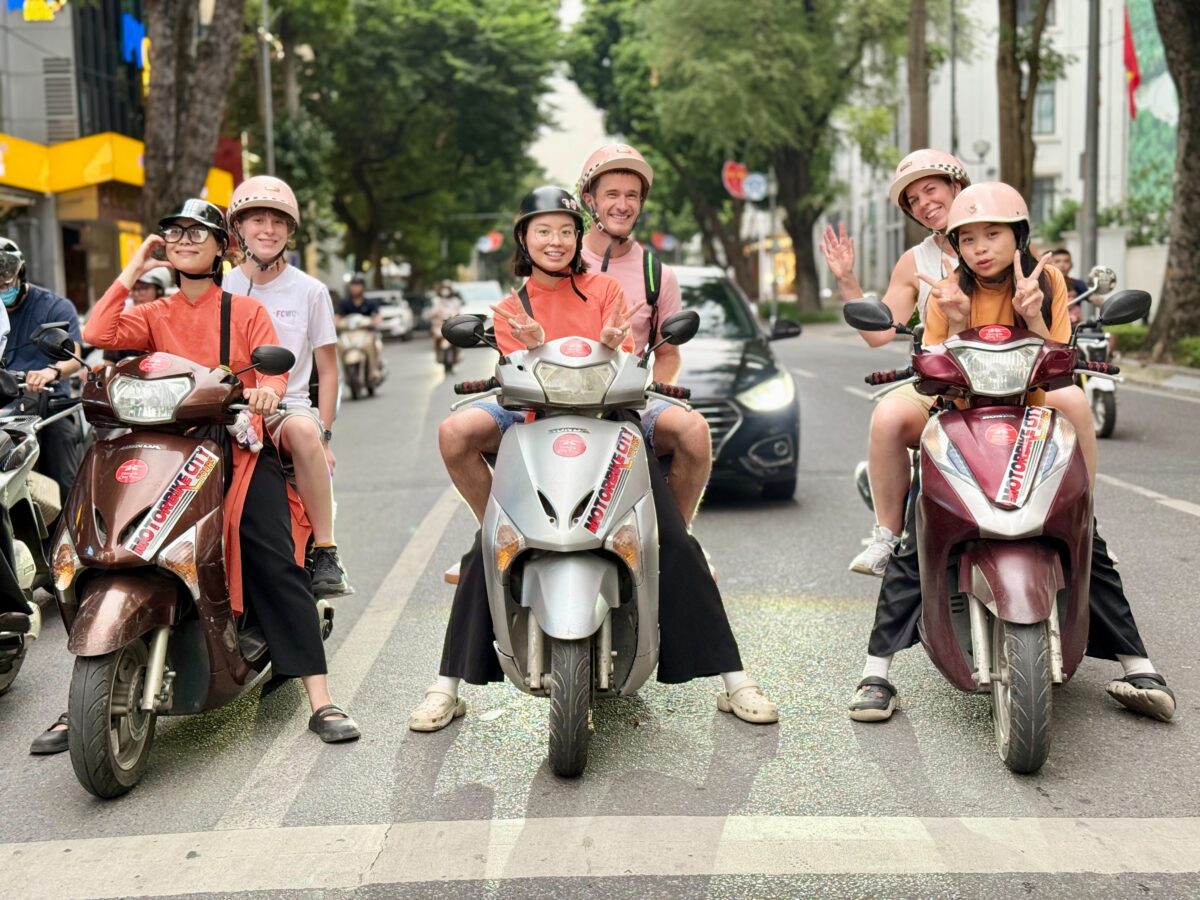
Hanoi Vespa Route: From Colonial Streets to Local Communities
A Hanoi Vespa Route is much more than a ride between famous attractions. The best routes connect the elegant architecture of Hanoi’s colonial center with narrow Old Quarter streets, historic bridges, lakeside neighborhoods, local markets, Red River communities and quieter areas where everyday Vietnamese life continues away from the main tourist streets. Riding as a passenger on a classic Vespa makes it possible to experience these contrasting sides of Hanoi in one journey, while a local guide explains the history, food and culture along the way.
For travelers searching for the best Hanoi Vespa Tours, route design is one of the most important things to consider. A good itinerary should not simply stop at five famous landmarks and return to the hotel. It should show how Hanoi changes from the historic city center to residential neighborhoods and finally to local communities around the Red River. Asia Vespa Tours currently promotes small-group and women-led vintage Vespa experiences that combine colonial boulevards, hidden backstreets, markets, lakes, historical landmarks, local food and authentic neighborhood encounters.
Why the Route Matters More Than the Vespa
The classic Vespa is certainly part of the attraction, but the route is what determines how much of Hanoi you actually experience. A short ride around the Old Quarter can be enjoyable, but a carefully designed Hanoi Vespa route can take you through several different environments in just a few hours: French colonial architecture, traditional streets, the Red River, agricultural communities, local markets and modern neighborhoods.
This variety is particularly valuable for first-time visitors. Instead of seeing Hanoi as a collection of isolated attractions, you begin to understand how the historic center connects with the wider city and surrounding communities.
The Ideal Hanoi Vespa Route
A strong city-and-community route can follow this general direction:
French Quarter → Hanoi Opera House → Old Quarter → Long Bien Bridge → Red River → Local Communities → West Lake → Truc Bach Lake → Historic Neighborhoods → Local Food → Egg Coffee
The exact route should remain flexible according to traffic, weather, local access and the specific Vespa tour you book. Current Asia Vespa Tours experiences emphasize going beyond standard attractions into quiet backstreets, vibrant markets, lakeside neighborhoods, family-run cafés and authentic local communities.
1. Begin in Hanoi’s Colonial Quarter
The journey can start in the French Quarter, where Hanoi’s urban landscape looks very different from the narrow streets of the Old Quarter.
Wide tree-lined avenues, historic buildings and French-influenced architecture create an elegant atmosphere. Riding through this area on a vintage Vespa is particularly photogenic because the classic scooter complements the architecture.
The French Quarter is a good introduction to Hanoi’s history because it shows how the city developed into an important administrative and cultural center during the colonial period.
2. Hanoi Opera House
One of the most recognizable landmarks in this area is the Hanoi Opera House.
Its grand façade and surrounding boulevards provide an immediate contrast with the small shop houses and narrow lanes that you will encounter later in the route.
A good Vespa guide does more than point at the building. They can explain how Hanoi’s architecture reflects different periods of the city’s history and how the French Quarter continues to function as an important part of modern Hanoi.
3. Ride From the French Quarter Into the Old Quarter
One of the most interesting moments of the route is the transition from the broad streets of the French Quarter into the compact Old Quarter.
Within a relatively short distance, the scenery changes dramatically.
Large colonial buildings give way to traditional tube houses, small cafés, street-food stalls, workshops and narrow commercial streets.
This contrast is one of the reasons a Vespa is such an effective way to explore Hanoi. You can move between these environments quickly while remaining close to the street.
4. Explore the Old Quarter
The Old Quarter is where Hanoi becomes intensely local and energetic.
The area is famous for its historic streets, traditional businesses, restaurants, cafés and street food. But instead of focusing only on the most photographed streets, a good Vespa route should include quieter lanes where you can see residents shopping, eating and going about their daily routines.
Asia Vespa Tours describes its experiences as going beyond typical tourist attractions into quiet backstreets, local markets and family-run cafés.
This is the point where the tour begins shifting from colonial Hanoi to everyday Hanoi.
5. Discover Hanoi’s Hidden Backstreets
The narrow streets surrounding the Old Quarter reveal a different side of the city.
You may see small family businesses, neighborhood cafés, food vendors, traditional houses and local residents sitting outside their homes.
These streets may not appear on a typical sightseeing itinerary, but they are essential for understanding how Hanoi actually functions.
The Vespa allows you to pass through these areas efficiently without turning the tour into a long walking excursion.
6. Head Toward Long Bien Bridge
After exploring the central streets, the route can continue toward Long Bien Bridge.
The historic bridge crosses the Red River and provides a dramatic transition between central Hanoi and the communities beyond it.
From the bridge, the city begins to open up. Buildings give way to river landscapes, agricultural land and wider views.
Long Bien Bridge is therefore more than a sightseeing stop. It acts as a gateway between urban Hanoi and the Red River communities.
7. Cross the Red River
Crossing the Red River by Vespa gives you a completely different perspective of Hanoi.
Behind you is the dense historic center.
Ahead are quieter landscapes, farms, villages and communities connected to the river.
This transition is one of the strongest moments of a well-designed Hanoi Vespa route because you can physically see the change from city to countryside.
8. Discover Red River Local Communities
Beyond the central city, the route can enter local communities along the Red River.
Here, life moves at a slower pace. You may encounter vegetable gardens, banana plantations, flower gardens, small roads and farmers working their land.
Current women-led scooter experiences from Asia Vespa Tours include routes through Red River villages, banana plantations and flower gardens, offering travelers a contrast between urban and rural Hanoi.
This is one of the most valuable parts of the experience for travelers who want to see something beyond conventional sightseeing.
9. See Hanoi’s Agricultural Side
It can be surprising to discover agricultural land so close to central Hanoi.
Vegetables, flowers, bananas and other crops are grown in areas surrounding the Red River. Local farmers continue to work these fields despite being only a short ride from the city’s busy center.
For international visitors, this provides an important perspective: Hanoi is not simply a modern capital filled with buildings and traffic. It still has strong connections to agriculture and rural communities.
10. Meet Local People
The best community-focused Vespa routes allow travelers to meet local people rather than simply photograph them.
Depending on the itinerary, this might involve visiting a local family, talking with residents through your guide, observing traditional work or stopping at a neighborhood market.
The goal is not to create a staged cultural performance. It is to provide a respectful opportunity to understand how people live.
Current Asia Vespa Tours experiences emphasize authentic neighborhood encounters and meaningful connections with local communities.
11. Visit a Local Market
A traditional market can reveal more about Hanoi’s daily life than a major monument.
You’ll see fresh vegetables, herbs, meat, seafood, fruit, household goods and small food stalls. You can also observe how local residents shop and interact with vendors.
A Vespa makes it easier to connect a market visit with other neighborhoods because you don’t need to remain in one district for the entire tour.
12. Return Toward the Historic City
After experiencing the quieter communities around the Red River, the route can gradually return toward central Hanoi.
The contrast becomes particularly noticeable.
You move from agricultural roads and village landscapes back into increasingly busy streets, cafés, shops and residential neighborhoods.
This gives the tour a natural story:
Colonial Hanoi → Old Hanoi → Red River → Local Communities → Modern Hanoi.
That is much more interesting than simply visiting a list of landmarks.
13. Explore West Lake
Back in the urban area, West Lake provides another change of atmosphere.
The lake is surrounded by residential areas, restaurants, cafés, temples and modern businesses. Compared with the Old Quarter, the roads around West Lake feel more open.
A Vespa ride beside the lake can be especially pleasant in the late afternoon when temperatures become more comfortable.
14. Stop at Truc Bach Lake
Nearby Truc Bach Lake offers a quieter urban landscape.
The lake is closely connected to Hanoi’s history and local neighborhoods, while its surrounding streets provide excellent opportunities to observe everyday city life.
This part of the route demonstrates that local communities are not limited to rural villages. Hanoi’s urban neighborhoods also have strong local identities.
15. Discover the City’s Historical Layers
A well-designed Hanoi Vespa route should tell the story of the city through its architecture and neighborhoods.
You may move between:
Colonial buildings → traditional tube houses → wartime landmarks → modern cafés → residential neighborhoods → rural communities.
This is what makes Hanoi different from a city where every district looks similar.
The city has developed in layers, and the Vespa route allows you to move through those layers within a single experience.
16. Stop for Local Food
Food should be part of the route rather than an afterthought.
Depending on the tour, you may stop at family-run restaurants or local food stalls to try dishes such as:
- Bánh Cuốn
- Bún Chả
- Phở
- Phở Cuốn
- Vietnamese spring rolls
- Grilled seafood
- Local salads
- Vietnamese desserts
Asia Vespa Tours currently offers dedicated vintage Vespa food tours and describes its food experiences as combining local dishes with exploration of Hanoi’s neighborhoods.
17. Finish With Egg Coffee
A Hanoi Vespa experience can finish with one of the city’s most recognizable drinks: Vietnamese Egg Coffee.
The drink combines strong Vietnamese coffee with a rich, creamy egg topping.
Ending the tour in a local café creates a natural transition from sightseeing to conversation. You can sit with your guide, ask questions about Hanoi and reflect on the different communities you have seen during the journey.
Hanoi Vespa Route: City vs Local Communities
| Part of Route | What You Experience | Atmosphere |
|---|---|---|
| French Quarter | Colonial architecture | Elegant |
| Opera House | History & architecture | Grand |
| Old Quarter | Shops, food, daily life | Busy |
| Hidden lanes | Local neighborhoods | Authentic |
| Long Bien Bridge | Red River views | Scenic |
| Red River | Farming landscapes | Peaceful |
| Local communities | Rural life | Traditional |
| West Lake | Lakeside neighborhoods | Relaxed |
| Truc Bach | Local urban life | Quiet |
| Food stop | Vietnamese cuisine | Social |
| Egg Coffee | Hanoi café culture | Relaxed |
Why a Vespa Is Ideal for This Route
A large tour bus can take you between major landmarks, but it is less suited to narrow streets and small communities.
Walking gives you an intimate experience but limits how much ground you can cover.
A Vespa sits between the two.
It allows you to cover distance while remaining connected to the street.
You can move quickly when necessary and slow down when something interesting appears. You can enter smaller roads, pass through neighborhoods and reach areas that are difficult to include in a conventional city tour.
Hanoi Vespa Route for First-Time Visitors
If this is your first time in Hanoi, a balanced route should include both famous sights and local areas.
A recommended structure is:
French Quarter → Old Quarter → Long Bien Bridge → Red River communities → West Lake → local food → Egg Coffee.
This gives you architecture, history, local life, landscapes and food without spending the entire day around one neighborhood.
Hanoi Vespa Route for Returning Visitors
If you’ve already seen Hoan Kiem Lake, the Old Quarter and the main monuments, choose a route that focuses more heavily on local communities.
Consider:
Long Bien Bridge → Red River farming areas → local markets → villages → artisan communities → West Lake → hidden cafés.
This gives you a more unusual perspective of Hanoi and avoids repeating the standard sightseeing route.
Hanoi Vespa Route for Photographers
Photographers should consider a route that includes:
French Quarter → Old Quarter → Long Bien Bridge → Red River → farming communities → West Lake.
The variety of backgrounds is excellent.
You’ll have colonial architecture, colorful shop houses, railway scenes, river landscapes, farmland, traditional homes, markets and modern Hanoi.
The classic Vespa also provides a strong visual element in photographs.
Hanoi Vespa Route for Couples
For couples, an afternoon or sunset route can be particularly attractive.
Begin with the French Quarter and Old Quarter, continue toward Long Bien Bridge and the Red River, then return toward West Lake for sunset before finishing with Vietnamese food and coffee.
The combination of vintage Vespa + Hanoi architecture + sunset + local food creates a more memorable experience than a conventional city sightseeing tour.
How Long Should a Hanoi Vespa Route Take?
A route connecting colonial Hanoi, the Old Quarter, Long Bien Bridge and local communities should ideally allow at least 3.5–4.5 hours.
A shorter 2.5-hour experience can work if your focus is mainly central Hanoi.
For a deeper city-and-countryside route, a half-day or full-day experience provides more time to stop, take photographs and interact with local communities.
Asia Vespa Tours currently offers several formats, including shorter 2.5-hour tours, city and food tours, sunset and night tours, countryside tours and full-day city-and-countryside experiences.
Is the Route Safe?
The main safety advantage is that you are a passenger, not the person driving through Hanoi traffic.
Professional riders handle navigation and traffic while you enjoy the surroundings.
Choose an operator that provides experienced riders, helmets, insurance and properly maintained vehicles. Asia Vespa Tours currently states that its tours use professional riders, sanitized helmets and insurance.
Passengers should wear helmets correctly, keep their feet on the footrests and follow the guide’s instructions.
What Should You Wear?
For a Hanoi Vespa route, wear:
- Lightweight comfortable clothing
- Comfortable closed-toe shoes
- Sunglasses
- Sunscreen
- Light jacket during cooler weather
- Secure small bag
Avoid loose clothing that may become uncomfortable while riding.
Best Time to Take the Route
Morning is ideal for cooler temperatures and local markets.
Afternoon is good for combining city sightseeing with countryside communities.
Sunset is excellent for couples and photography.
Evening is best if you want street food and Hanoi nightlife.
For the specific route from colonial streets to local communities, morning or afternoon usually provides the best balance because you have enough daylight to appreciate both the architecture and rural landscapes.
Private vs Group Hanoi Vespa Route
A group Vespa tour is a good choice for solo travelers and visitors who enjoy meeting other people.
A private Vespa route is better if you want to control the pace, spend more time taking photographs, customize the route or travel with family and friends.
For travelers particularly interested in local communities, private tours can be valuable because there is more flexibility to stop and talk rather than following a fixed schedule.
The Best Hanoi Vespa Route Is Not the Shortest Route
A common mistake is trying to fit as many attractions as possible into one itinerary.
The better approach is to create a route with contrasting experiences.
Instead of:
Attraction → Attraction → Attraction → Hotel
choose:
Architecture → Neighborhood → Bridge → River → Community → Lake → Food → Café.
This gives the traveler a story rather than a checklist.
Final Thoughts
The most interesting Hanoi Vespa Route is one that moves beyond the famous center and shows how different parts of the city connect.
Start among the elegant colonial buildings of the French Quarter, move through the energetic Old Quarter, cross historic Long Bien Bridge and follow the Red River toward agricultural landscapes and local communities. Then return to Hanoi through West Lake and Truc Bach before finishing with Vietnamese food and Egg Coffee.
The route reveals two sides of Hanoi that travelers often experience separately: the historic capital and the living communities around it.
That is why a Vespa tour can be more than sightseeing. You are not simply looking at Hanoi—you are moving through its history, neighborhoods, food culture and everyday life.
Book a Hanoi Vespa Tour
Asia Vespa Tours — asiavespatours.com offers women-led vintage Vespa experiences in Hanoi, including city, countryside, food, sunset, night and full-day tours. Its published experiences focus on hidden streets, local communities, markets, lakes, historic landmarks and authentic Vietnamese food.
Asia Vespa Tours — asiavespatours.com
24/7 WhatsApp: +84 982 416 518
Email: info@asiavespatours.com
From Hanoi’s colonial boulevards to the quiet communities along the Red River, the right Vespa route lets you experience the city as a journey—not just a list of attractions.