
Phu Yen Guide: Complete Travel Guide to Beaches, Ganh Da Dia, Mui Dien, Bai Xep and Coastal Villages
Phu Yen is one of Central Vietnam’s most rewarding destinations for travelers who prefer open landscapes, quiet beaches, fishing villages and scenic coastal roads over crowded resort cities. Located along the South Central Coast, Phu Yen stretches from Xuan Dai Bay in the north to Hon Nua in the south, with around 189 kilometres of coastline. The province combines long sandy beaches, volcanic rock formations, lagoons, mountains, rice fields, fishing villages and historic sites. Its landscapes remain relatively peaceful, making Phu Yen especially attractive for travelers who want to slow down and experience a less commercial side of Vietnam.

Where Is Phu Yen?
Phu Yen is located on Vietnam’s south-central coast between Binh Dinh Province and Khanh Hoa Province. Its main city is Tuy Hoa, a compact coastal city that works as the most convenient base for exploring the province.
The geography is one of Phu Yen’s greatest advantages. You can stay in Tuy Hoa and reach beaches, lagoons, fishing villages and historical attractions in different directions. The northern part of the province leads toward Tuy An, O Loan Lagoon, Mang Lang Church and Ganh Da Dia, while the southern route takes you toward Vung Ro Bay, Dai Lanh Lighthouse, Mui Dien and Bai Mon.
This makes Phu Yen particularly good for a road-trip style holiday. Rather than spending the entire trip inside one resort, you can travel along the coast and stop whenever a landscape catches your attention.
Why Visit Phu Yen?
Phu Yen is ideal for travelers who want to see Vietnam’s coastline before it becomes heavily developed.
The province has dramatic volcanic rock formations at Ganh Da Dia, golden grass-covered cliffs at Bai Xep, a spectacular sunrise location at Mui Dien, peaceful fishing villages, the expansive O Loan Lagoon, historic Cham architecture and long stretches of coastline.
The experience is less about ticking off dozens of attractions and more about driving through beautiful scenery, eating fresh seafood and finding quiet places beside the sea.
Phu Yen is also an excellent destination for photographers because the landscape changes constantly between beaches, cliffs, lagoons, rice fields, fishing boats and mountains.
Tuy Hoa
Tuy Hoa is the capital and main urban center of Phu Yen.
The city is relatively easy to explore and has a long beachfront, wide streets, restaurants, cafés and hotels. Unlike larger coastal cities such as Da Nang or Nha Trang, Tuy Hoa generally feels slower and less crowded.
The city is best used as a base for exploring the province.
Stay in Tuy Hoa, have breakfast near the beach, take a private car or motorbike into the countryside during the day and return to the city for dinner.
Tuy Hoa Beach
Tuy Hoa Beach runs along the eastern side of the city and is one of the easiest places to enjoy the coast.
The beach is long and spacious, with a promenade running alongside parts of the shoreline.
Early morning is especially interesting because local residents exercise, walk and swim before the heat becomes intense.
At sunset, the beach becomes a relaxing place for a walk.
Unlike a highly developed resort beach, Tuy Hoa still feels connected to the everyday life of the city.
Nghinh Phong Tower
Nghinh Phong Tower has become one of Tuy Hoa’s most recognizable modern landmarks.
Its design draws inspiration from the natural geometry of Ganh Da Dia and incorporates local cultural references.
The tower is particularly attractive around sunrise and sunset when the light creates strong shadows between the structures.
It is an easy stop when exploring Tuy Hoa and works well as a short photography visit rather than an attraction that requires several hours.
Nhan Tower
Nhan Tower is one of Phu Yen’s most important historical landmarks.
The ancient Cham tower stands on Nhan Mountain overlooking Tuy Hoa and the Da Rang River.
The tower is associated with the Cham people and dates to around the late 11th century. Its elevated position provides views across the city and surrounding landscape.
Visit in the late afternoon when the temperature becomes more comfortable.
The combination of the ancient brick tower, mountain and modern city below creates an interesting contrast.
Ganh Da Dia
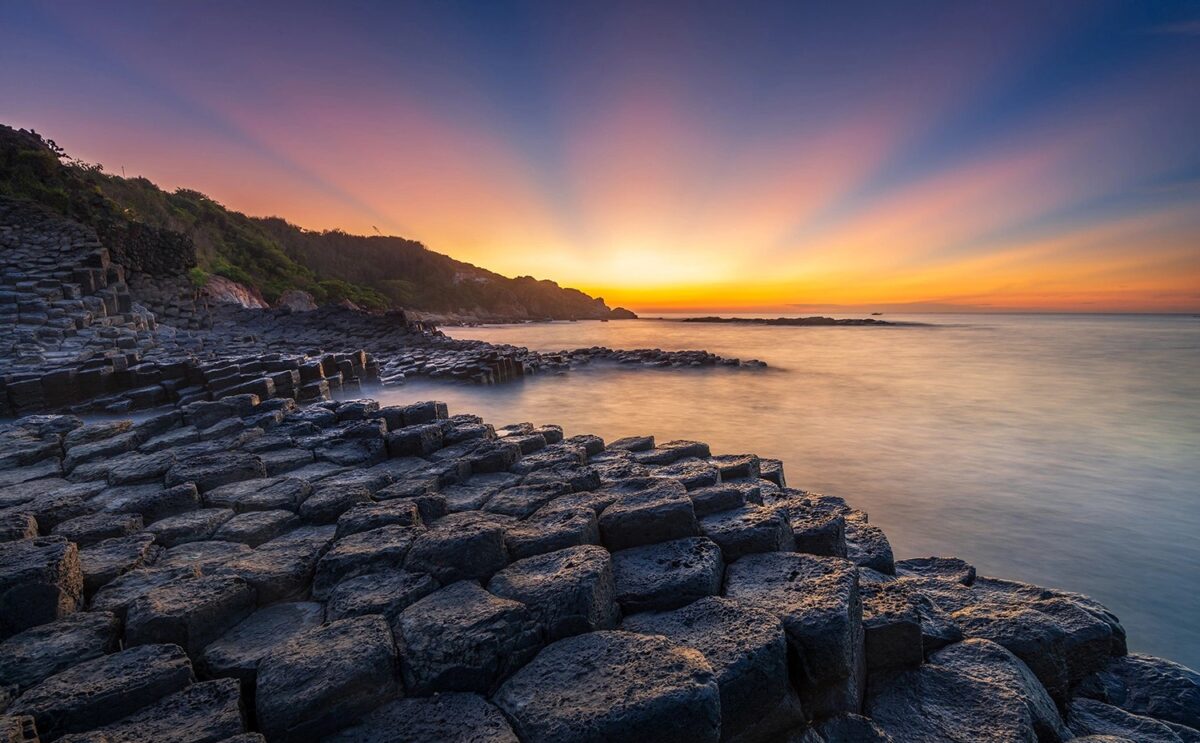
Ganh Da Dia, also known as Da Dia Reef or the Reef of Plates, is the signature attraction of Phu Yen.
The site consists of thousands of dark basalt columns packed together along the coast, with many rocks appearing as hexagonal or circular shapes.
The unusual geological formation was created by volcanic activity. Molten basalt cooled rapidly after reaching the sea, producing fractures that formed the distinctive columns visible today.
The main rocky area is relatively compact, but its unusual geometry makes it one of the most visually impressive places on the Central Coast.

How to Experience Ganh Da Dia
Do not simply arrive, take one photograph and leave.
Walk slowly across the viewing area and look at the different patterns created by the basalt columns.
The surrounding coastline is also worth exploring.
The official Phu Yen tourism information describes the formation as roughly 50 metres wide and more than 200 metres long, while nearby landscapes include beaches, fishing villages and Ganh Den Lighthouse.
The rocks themselves are not a conventional swimming beach, so if you want to swim, use a suitable nearby beach instead.
Best Time to Visit Ganh Da Dia
Ganh Da Dia can be visited throughout the year, but January to August generally offers more favorable conditions for exploring Phu Yen, with the province’s wetter season typically occurring from September to December.
For photography, early morning is excellent because the sunlight creates strong contrast between the black rocks and blue sea.
Avoid walking directly onto wet rocks when waves are strong. The basalt surface can become extremely slippery.
Ganh Den Lighthouse
Ganh Den Lighthouse is located near Ganh Da Dia and provides another perspective on the coastline.
The lighthouse sits above rocky terrain overlooking the sea.
Because it is close to Ganh Da Dia, the two attractions can easily be combined in the same morning.
A good route is:
Ganh Da Dia → Ganh Den Lighthouse → nearby fishing village → O Loan Lagoon
O Loan Lagoon
O Loan Lagoon is one of Phu Yen’s most important natural landscapes.
The large brackish-water lagoon is surrounded by low hills and fishing communities and is particularly famous for its seafood.
The lagoon is best experienced slowly.
Stop for lunch, order fresh seafood and enjoy the view rather than simply driving around the shoreline.
O Loan Lagoon Seafood
The most famous specialty from O Loan is blood cockle, or so huyet.
It can be grilled, steamed, stir-fried or prepared with other local ingredients.
The lagoon is also associated with various shellfish, fish and other seafood.
For food travelers, an O Loan lunch is one of the strongest reasons to include the northern coastal route in a Phu Yen itinerary.
Mang Lang Church
Mang Lang Church is one of the oldest Catholic churches in Vietnam and one of Phu Yen’s most distinctive architectural landmarks.
The church features Gothic-inspired architecture with pointed forms, decorative details and a distinctive facade.
The surrounding grounds are relatively peaceful, making it a good cultural stop between O Loan Lagoon and Ganh Da Dia.
Vietnam Tourism notes the church’s connection with the history of Vietnamese Catholicism and the story of Saint Andrew Phu Yen.
Phu Yen and Vietnamese Quoc Ngu
Mang Lang Church is particularly significant for travelers interested in Vietnamese language history.
The site is associated with Alexandre de Rhodes and the development of the Romanized Vietnamese writing system.
A guide can provide much more historical context than simply visiting the building independently.
This makes Mang Lang particularly valuable for travelers interested in culture and history.
Bai Xep
Bai Xep is one of the most recognizable beaches in Phu Yen.
The landscape combines a golden sandy beach, rocky headlands, green grass and coastal vegetation.
The location became widely known after appearing in the Vietnamese film I See Yellow Flowers on the Green Grass, which brought additional attention to the province. Phu Yen tourism information identifies Bai Xep as one of the province’s signature landscapes.
The best photographs are taken from the grassy viewpoint above the beach.

Bai Xep and Ghềnh Ông
The elevated grassy area around Bai Xep provides panoramic views over the beach and ocean.
This is one of the most photogenic landscapes in Phu Yen.
The contrast between the green hillside, golden vegetation, dark rocks and turquoise water creates a scene that looks very different from Vietnam’s more developed resort beaches.
Visit early or late in the day to avoid the strongest heat.
Bai Mon
Bai Mon is a small, beautiful beach located beneath Mui Dien.
It is surrounded by mountains and feels much more secluded than Tuy Hoa Beach.
The beach is especially attractive when viewed from the path leading toward the lighthouse.
Vietnam Tourism describes Bai Mon as a secluded stretch of sand surrounded by mountains, with the lighthouse above it.
Mui Dien
Mui Dien, also known as Dai Lanh Cape, is one of the most famous sunrise locations in Vietnam.
The dramatic headland extends into the sea and is topped by the historic Dai Lanh Lighthouse.
Travelers climb the path toward the lighthouse before sunrise, then look out over the sea as the first light appears on the horizon.
The experience requires an early start, but the scenery makes it worthwhile.
Dai Lanh Lighthouse
The lighthouse has stood above the coast for more than a century and remains one of the defining landmarks of southern Phu Yen.
The climb involves stairs and walking, so comfortable shoes are recommended.
The area can become hot quickly after sunrise.
If you are visiting in the morning, arrive early rather than attempting the climb after the sun is already high.
Is Mui Dien Really Vietnam’s First Sunrise?
You will often see Mui Dien promoted as the place where Vietnam’s mainland sees the first sunrise.
This description is popular in tourism marketing, but the exact geographic claim depends on the reference point and should not be treated as an absolute scientific distinction.
What is beyond question is that Mui Dien is one of the country’s most spectacular places for watching sunrise.
That is the reason to visit.

Vung Ro Bay
Vung Ro Bay lies in the southern part of Phu Yen near the border with Khanh Hoa Province.
The bay is surrounded by mountains and has a sheltered, dramatic landscape.
Fishing boats and floating seafood restaurants are part of the scenery.
The bay also has historical significance connected to the maritime supply route during the Vietnam War.
For travelers interested in both scenery and history, Vung Ro is a worthwhile stop on the southern coastal route.
Vung Ro Seafood
Vung Ro is an excellent place for fresh seafood.
Depending on the season and catch, restaurants may offer:
Prawns
Squid
Crab
Fish
Shellfish
Seafood hotpot
A meal beside the water is one of the most enjoyable experiences on a Phu Yen road trip.
Hon Nua
Hon Nua is a small island located near the southern coastal area of Phu Yen.
The island has rugged cliffs, clear water and a relatively undeveloped atmosphere.
Boat access depends on weather and local arrangements, so it should not be treated as a guaranteed year-round excursion.
For travelers with additional time, however, it can provide a quieter island experience.
Xuan Dai Bay
In northern Phu Yen, Xuan Dai Bay offers another scenic coastal environment.
The bay is surrounded by hills and fishing communities and is particularly attractive for travelers who want to explore beyond the province’s most famous attractions.
This area can be incorporated into a longer northern Phu Yen road trip.
Phu Yen Fishing Villages
Fishing is still central to life along the coast.
Early morning is the best time to see fishing boats returning, seafood being unloaded and residents beginning their daily work.
Travel slowly and respectfully.
Do not block working areas or photograph people closely without permission.
For photographers, these villages can provide more meaningful images than heavily visited tourist attractions.
Phu Yen Rice Fields
Phu Yen is not only about beaches.
Drive inland and you will find rice fields, rivers, low mountains and agricultural communities.
The contrast between green fields and blue coastal mountains makes the countryside particularly attractive during the growing season.
A private car or motorbike is the best way to explore these areas because you can stop whenever you find an interesting landscape.
Phu Yen Coastal Road Trip
A road trip is arguably the best way to experience the province.
Instead of treating attractions as isolated points, connect them into a route.
A northern route could include:
Tuy Hoa → Bai Xep → Mang Lang Church → O Loan Lagoon → Ganh Da Dia → Ganh Den
A southern route could include:
Tuy Hoa → Mui Dien → Bai Mon → Vung Ro Bay → Hon Nua
This division makes it easier to plan realistic days without spending excessive time driving back and forth.
Phu Yen Food
Phu Yen’s food is strongly influenced by its coastal location.
Seafood is the obvious highlight, but the province also has distinctive regional dishes that are difficult to find elsewhere.
Important foods to try include:
Banh Canh He
Banh Xeo
Bun Ca
Mat Ca Ngu
So Huyet O Loan
Fresh grilled seafood
Tuna dishes
Tuna in Phu Yen
Tuna is one of the province’s best-known seafood products.
You can find several preparations, including tuna eye cooked with medicinal herbs, tuna stomach salad and fresh tuna served with herbs.
Tuna eye is particularly associated with Phu Yen and is worth trying if you want a distinctly regional dish. The Phu Yen tourism guide specifically highlights tuna eye and other tuna preparations among local specialties.
Tuna Eye
Mat Ca Ngu, or tuna eye, may sound unusual to international travelers.
The dish is typically slow-cooked with herbs and spices, producing a rich broth and tender texture.
It is one of those Vietnamese dishes that provides a cultural experience beyond familiar tourist food.
If you enjoy trying regional specialties, put it on your list.
Banh Canh He
Banh Canh He is a simple noodle dish associated with Phu Yen.
The soup uses thick rice or tapioca noodles, fish-based broth, fish cake and a generous amount of chives.
It is especially good for breakfast.
Phu Yen Seafood
If you love seafood, do not limit yourself to one restaurant.
Try seafood in different settings:
Tuy Hoa restaurants
O Loan Lagoon
Vung Ro Bay
Fishing villages
The style changes from place to place, but the emphasis is usually on fresh ingredients and simple preparation.
Best Time to Visit Phu Yen
Phu Yen has two broadly defined seasons.
The drier and sunnier period is generally January to August, while September to December tends to be wetter. The official Phu Yen tourism guide recommends the sunny months for easier sightseeing and beach activities.
For a classic beach and road-trip holiday, February through August is generally the safest choice.
For photography, the shoulder months can offer softer light and fewer visitors.
During periods of heavy rain, sea conditions can affect boat trips and coastal activities.
Phu Yen in Spring
February through April can be particularly pleasant for sightseeing.
Temperatures are generally comfortable enough for long drives, while the beaches remain attractive.
This is a good period for combining:
Ganh Da Dia
Bai Xep
Mui Dien
O Loan Lagoon
Tuy Hoa
Phu Yen in Summer
May through August is ideal for travelers who prioritize beaches and swimming.
The weather is hotter, so start sightseeing early.
A good schedule is:
05:00–08:00: sunrise and outdoor sightseeing
08:00–11:30: coastal attractions
11:30–14:30: lunch and rest
15:00–18:00: beach or sightseeing
Evening: seafood and city walk
Phu Yen in the Rainy Season
September through December can be more unpredictable.
Heavy rain and rough seas may affect boat excursions.
However, the city, restaurants, historical sites and road attractions remain available.
If traveling during this period, build flexibility into your itinerary and avoid scheduling every day around an island or boat trip.
How to Get to Phu Yen
The easiest access point is Tuy Hoa Airport, located close to the provincial capital.
Domestic flights can connect Tuy Hoa with major Vietnamese cities.
The railway is another option, with trains traveling along Vietnam’s north-south railway line.
Buses and private cars provide additional choices.
For travelers coming from Hanoi or Ho Chi Minh City, flying is usually the most practical option if time is limited.
From Hanoi to Phu Yen
For a comfortable trip from Hanoi, fly to Tuy Hoa and arrange a private transfer.
A road-only journey takes considerably longer.
If you are building a premium Vietnam itinerary, combining domestic flights with private transportation allows you to spend more time exploring Phu Yen rather than sitting in transit.
From Ho Chi Minh City to Phu Yen
Flying from Ho Chi Minh City to Tuy Hoa is the easiest option when available on your travel dates.
Alternatively, the railway provides a scenic overland journey for travelers who enjoy train travel.
For a premium itinerary, however, flying is generally more efficient.
From Quy Nhon to Phu Yen
Quy Nhon and Phu Yen are an excellent combination because they offer different versions of the Central Coast.
Quy Nhon: Ky Co, Eo Gio, seafood and Cham heritage.
Phu Yen: Ganh Da Dia, Bai Xep, Mui Dien, O Loan Lagoon and quieter coastal roads.
A private car makes the journey especially convenient.
From Nha Trang to Phu Yen
Phu Yen is also a logical stop north of Nha Trang.
The route allows travelers to experience a quieter coastline before continuing south to the larger resort city.
A private road transfer is ideal for travelers who want to stop at Vung Ro Bay and other scenic locations along the way.
Getting Around Phu Yen
Private car: Best for families, couples and multi-stop itineraries.
Motorbike: Excellent for experienced riders who enjoy coastal roads.
Taxi: Useful inside Tuy Hoa but less practical for full-day sightseeing.
Walking: Suitable for central Tuy Hoa.
For first-time visitors, a private vehicle is the most comfortable option because the attractions are spread across the province.
Where to Stay in Phu Yen
Tuy Hoa City
Best for first-time visitors and travelers who want restaurants, cafés, shops and easy access to the beach.
Tuy Hoa Beachfront
Ideal for travelers who want a hotel close to the sea.
Bai Xep Area
Better for travelers looking for a quieter coastal atmosphere.
Northern Coast
Suitable for travelers focusing on Ganh Da Dia, O Loan and Mang Lang Church.
Southern Coast
Ideal for travelers focusing on Mui Dien, Bai Mon and Vung Ro.
For a short visit, Tuy Hoa is the most practical base.
How Many Days Do You Need in Phu Yen?
2 days: possible, but you will need to prioritize.
3 days: good for first-time visitors.
4 days: ideal for seeing both northern and southern highlights.
5 days: excellent for a slower premium journey.
If you have only two days, prioritize:
Bai Xep + Ganh Da Dia + O Loan
and
Mui Dien + Bai Mon + Vung Ro
Phu Yen 2-Day Itinerary
Day 1: Start early with Bai Xep and the coastal landscape around Ghềnh Ông. Continue north to Mang Lang Church and O Loan Lagoon for lunch and seafood. Spend the afternoon at Ganh Da Dia and Ganh Den before returning to Tuy Hoa for dinner.
Day 2: Leave Tuy Hoa before sunrise and travel south toward Mui Dien. Climb to Dai Lanh Lighthouse and enjoy the sunrise before descending to Bai Mon Beach. Continue to Vung Ro Bay for seafood lunch and spend the afternoon exploring the southern coastline before returning to Tuy Hoa.
Phu Yen 3-Day Itinerary
Day 1: Explore Tuy Hoa, including the beach, Nghinh Phong Tower and Nhan Tower. Spend the evening enjoying local food and seafood.
Day 2: Follow the northern coastal route through Bai Xep, Mang Lang Church, O Loan Lagoon, Ganh Da Dia and Ganh Den.
Day 3: Start before dawn for Mui Dien and Bai Mon, then continue to Vung Ro Bay. Return to Tuy Hoa in the late afternoon and enjoy a final seafood dinner.
Phu Yen 4-Day Itinerary
Day 1: Tuy Hoa city, beach, Nhan Tower, Nghinh Phong Tower and local food.
Day 2: Bai Xep, Mang Lang Church, O Loan Lagoon, Ganh Da Dia and Ganh Den.
Day 3: Mui Dien, Bai Mon and Vung Ro Bay.
Day 4: Keep the final day flexible for a beach morning, fishing village visit, countryside drive or island excursion depending on weather and sea conditions.
Phu Yen 5-Day Itinerary
Five days allows you to experience the province without rushing.
Day 1: Tuy Hoa and its beaches.
Day 2: Northern coastline and Ganh Da Dia.
Day 3: Southern coast, Mui Dien and Vung Ro.
Day 4: O Loan Lagoon, fishing villages and countryside.
Day 5: Free beach day or island excursion.
This is particularly suitable for couples and travelers who want a relaxed coastal holiday rather than a sightseeing marathon.
Phu Yen for Couples
Phu Yen is an excellent destination for couples who want quiet scenery.
A romantic itinerary could include:
Sunrise at Mui Dien
Breakfast beside Bai Mon
Private coastal drive
Seafood lunch at O Loan
Sunset at Bai Xep
Beachfront dinner in Tuy Hoa
The province’s quieter atmosphere is a major advantage for couples.
Phu Yen for Families
Families can enjoy Phu Yen, but the itinerary should be paced carefully.
Choose beaches with easier access and avoid trying to visit the entire coastline in one day.
Bai Xep, Tuy Hoa Beach, Ganh Da Dia and O Loan are relatively easy additions to a family itinerary.
For young children, avoid slippery rocks and always supervise them near the sea.
Phu Yen for Adventure Travelers
Adventure travelers can explore the province by motorbike, hike coastal viewpoints, explore fishing villages, swim at quieter beaches and take boat trips when conditions are suitable.
The roads between attractions are part of the experience.
A motorbike route through the countryside can be particularly rewarding early in the morning.
Phu Yen for Photographers
Phu Yen is one of the strongest destinations in Central Vietnam for landscape photography.
Sunrise: Mui Dien.
Morning: Bai Mon.
Midday: Ganh Da Dia.
Afternoon: Bai Xep.
Golden hour: O Loan Lagoon.
Blue hour: Tuy Hoa waterfront.
The province provides an unusually wide range of textures and colors within relatively short driving distances.
Phu Yen for History Lovers
Phu Yen is not only a beach destination.
Travelers interested in history can visit:
Nhan Tower
Mang Lang Church
Vung Ro historical sites
Cham cultural landmarks
The region’s history reflects several layers of Vietnamese and Cham civilization as well as its role in modern Vietnamese history.
Phu Yen vs Quy Nhon
Quy Nhon has a more developed tourist infrastructure and a larger urban beach scene.
Phu Yen feels quieter and more rural.
Choose Quy Nhon for Ky Co, Eo Gio, seafood and a livelier coastal city.
Choose Phu Yen for Ganh Da Dia, Mui Dien, Bai Xep, lagoons and long scenic drives.
Combining both is even better if you have enough time.
Phu Yen vs Nha Trang
Nha Trang is a major resort destination with extensive hotels, nightlife and island tours.
Phu Yen is quieter and more nature-focused.
Choose Nha Trang if you want a classic resort holiday with extensive tourist infrastructure.
Choose Phu Yen if you want coastal landscapes, fishing villages and a slower pace.
What to Pack for Phu Yen
Bring:
Swimwear
Light clothing
Sunscreen
Hat
Sunglasses
Walking shoes
Sandals
Light rain jacket
Reusable water bottle
Small backpack
For Mui Dien and Ganh Da Dia, proper walking shoes are better than flip-flops.
Phu Yen Travel Safety
The main risks in Phu Yen are related to heat, sun exposure, slippery rocks and sea conditions.
Start early for outdoor activities.
Use sunscreen regularly.
Do not climb unstable rocks around Ganh Da Dia or other coastal cliffs.
Be careful around waves and never underestimate the sea.
Check weather conditions before boat trips.
If riding a motorbike, take care on rural and coastal roads, particularly after rain.
Responsible Travel in Phu Yen
Phu Yen’s greatest attraction is its relatively untouched coastline.
Help preserve it.
Do not leave plastic on beaches or in fishing villages.
Do not collect rocks from Ganh Da Dia.
Avoid stepping on fragile vegetation around Bai Xep.
Do not disturb fishing equipment.
Ask before photographing local residents.
Support small restaurants and family-run businesses when possible.
The less developed character of Phu Yen is exactly what makes the destination valuable.
Phu Yen Travel Tips
Stay at least three nights if possible.
Start early for Mui Dien and coastal sightseeing.
Use Tuy Hoa as your base for a first visit.
Combine Ganh Da Dia with O Loan Lagoon and Mang Lang Church.
Combine Mui Dien with Bai Mon and Vung Ro.
Try tuna eye. It is one of the region’s distinctive specialties.
Eat seafood at O Loan Lagoon.
Visit Bai Xep around sunrise or late afternoon.
Bring good walking shoes.
Check sea conditions before island trips.
Leave time for the road itself. The landscapes between attractions are part of Phu Yen’s appeal.
Is Phu Yen Worth Visiting?
Phu Yen is one of the best choices in Vietnam for travelers who want a quieter coastal experience.
It does not have the nightlife of Nha Trang, the urban scale of Da Nang or the historical atmosphere of Hoi An.
Instead, it offers something different: long beaches, dramatic cliffs, volcanic rock formations, fishing villages, lagoons, ancient Cham architecture, fresh seafood and beautiful coastal roads.
The most memorable experience may not be a single attraction.
It may be watching the sunrise at Mui Dien, eating seafood beside O Loan Lagoon, standing above Bai Xep with the ocean stretching into the distance, or walking across the strange basalt columns at Ganh Da Dia.
For a first visit, three to four days is an excellent amount of time.
For travelers with more time, Phu Yen becomes even more rewarding when combined with Quy Nhon, Nha Trang or Da Lat.
Explore Phu Yen With Vietnam Women Travel
Vietnam Women Travel – Premium Private Tours Led by Women can create a private Phu Yen journey focused on the parts of the province that best match your interests.
A private itinerary can include Tuy Hoa Beach, Nghinh Phong Tower, Nhan Tower, Bai Xep, Ganh Da Dia, Ganh Den Lighthouse, O Loan Lagoon, Mang Lang Church, Mui Dien, Dai Lanh Lighthouse, Bai Mon, Vung Ro Bay and local fishing villages.
For couples, the itinerary can emphasize sunrise, secluded beaches, scenic coastal drives and private seafood dinners. Families can enjoy shorter sightseeing routes with comfortable private transportation. Photography-focused travelers can build their itinerary around sunrise, fishing villages, volcanic landscapes and coastal viewpoints. Travelers interested in culture can combine Cham heritage, Mang Lang Church and the historical sites of southern Phu Yen.
Phu Yen also works beautifully as part of a longer Central Vietnam journey:
Hanoi → Hue → Da Nang → Hoi An → Quy Nhon → Phu Yen → Nha Trang → Ho Chi Minh City
or:
Hanoi → Hoi An → Quy Nhon → Phu Yen → Da Lat → Ho Chi Minh City
With private transportation, carefully selected hotels and domestic flights where appropriate, Vietnam Women Travel can create a comfortable premium itinerary while allowing enough time to experience the landscapes rather than simply passing through them.
Vietnam Women Travel – Premium Private Tours Led by Women
Website: https://vietnamwomentravel.com/
Hotline / WhatsApp: +84 988 402 008 | +84 982 416 518 | +84 981 090 989
Email: info@vietnamwomentravel.com
Phu Yen Guide | Phu Yen Travel Guide | Phu Yen Vietnam | Tuy Hoa Guide | Ganh Da Dia | Bai Xep | Mui Dien | Dai Lanh Lighthouse | Bai Mon | O Loan Lagoon | Mang Lang Church | Nhan Tower | Vung Ro Bay | Phu Yen Beaches | Phu Yen Seafood | Phu Yen Itinerary | Phu Yen Travel Tips | Central Vietnam Travel Guide