
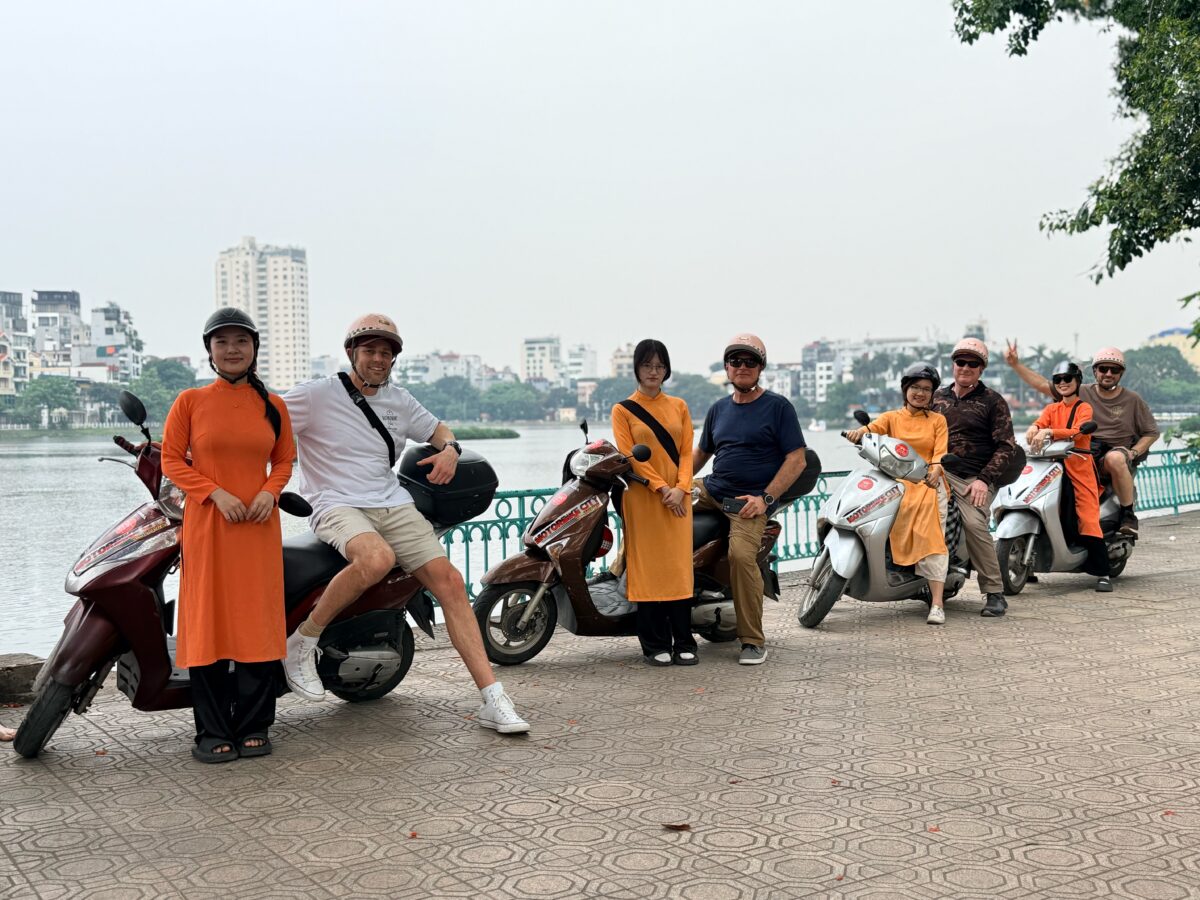
Hanoi Vespa Cultural Tour: Discover the City’s Living Heritage
A Hanoi Vespa Cultural Tour offers a different way to understand Vietnam’s capital—not simply through monuments and museums, but through the streets, neighborhoods, food, architecture and people that keep Hanoi’s heritage alive. Riding as a passenger on a classic Vespa, you can move from the elegant French Quarter into the historic Old Quarter, continue toward Long Bien Bridge and the Red River, explore local communities and return through lakeside neighborhoods and hidden streets. The result is a cultural journey that connects Hanoi’s past with its everyday present.
For travelers looking for the best Hanoi Vespa Cultural Tour, the most important question is not how many attractions appear on the itinerary. It is whether the route gives you opportunities to see how local people actually live. Asia Vespa Tours describes its Hanoi experiences as women-led, small-group journeys through quiet backstreets, vibrant markets, colonial boulevards, lakeside neighborhoods, historical landmarks, family-run cafés and authentic local food.
What Is a Hanoi Vespa Cultural Tour?
A Hanoi Vespa Cultural Tour is a guided experience that combines vintage Vespa riding, Hanoi sightseeing, local history and everyday Vietnamese culture. You ride as a passenger behind a professional local rider, so you do not need to know how to operate a Vespa or navigate Hanoi traffic.
The real attraction is the combination of movement and cultural discovery. Instead of visiting one historical site and then returning to your hotel, you travel through different neighborhoods and see how Hanoi changes from one district to another. A single route can include colonial architecture, traditional houses, markets, lakes, railway neighborhoods, river landscapes, local restaurants and residential communities.
What Does “Living Heritage” Mean in Hanoi?
Living heritage is the culture that continues to exist in people’s everyday lives. In Hanoi, it can be found in an old family house, a neighborhood market, a traditional café, a street-food stall, a craft workshop, a temple, a local festival or simply the way residents gather on the pavement in the evening.
This is what makes a cultural Vespa tour different from a conventional sightseeing itinerary. You are not only looking at buildings from the outside. You are seeing how history continues to influence modern Hanoi.
Why Explore Hanoi by Vintage Vespa?
A vintage Vespa provides a particularly atmospheric way to experience Hanoi because you remain close to the street. You can see shop fronts, smell street food, hear conversations and observe local life as you travel between destinations.
A large bus can take you efficiently between major attractions, while walking gives you excellent access to a small area. A Vespa combines elements of both: you can cover a considerable distance while remaining connected to the neighborhoods you pass through.
Asia Vespa Tours currently positions its vintage Vespa experiences around authentic neighborhood encounters rather than only conventional tourist attractions.
Hanoi Vespa Cultural Route: From History to Everyday Life
A strong cultural route can connect:
French Quarter → Hanoi Opera House → Old Quarter → Long Bien Bridge → Red River communities → historical neighborhoods → West Lake → local food → Vietnamese coffee.
The exact route depends on the tour selected, traffic, weather and local conditions, but this structure creates a natural story of Hanoi: colonial city, traditional city, wartime history, local communities and modern urban life.
1. Start in the French Quarter
The French Quarter is one of the best places to begin a cultural exploration of Hanoi.
Wide tree-lined streets, colonial-era buildings and elegant public architecture create a strong contrast with the compact streets of the Old Quarter. Riding through this area on a classic Vespa also creates an interesting visual connection between the city’s historical architecture and the iconic European scooter.
Your guide can explain how different periods shaped Hanoi’s architecture and urban development.
2. Hanoi Opera House
The Hanoi Opera House is one of the most recognizable examples of French-influenced architecture in the capital.
But a cultural tour should go beyond taking a photograph. Your guide can explain the role of the surrounding district and how this part of Hanoi developed as the city expanded.
The Opera House also provides a useful introduction to one of Hanoi’s defining characteristics: different historical periods existing side by side.
3. Ride Into the Old Quarter
The transition from the French Quarter to the Old Quarter is one of the most interesting parts of the journey.
The broad avenues become narrower. Colonial buildings give way to traditional tube houses, small businesses, cafés, workshops and food stalls.
Suddenly, Hanoi feels much more intimate.
This contrast demonstrates that the city’s heritage is not contained inside museums. It is still visible in the way streets are organized, businesses operate and families live.
4. Discover Traditional Hanoi Streets
The Old Quarter is famous for its historic streets and traditional commercial life.
A good Vespa cultural route should allow you to look beyond the busiest tourist areas and explore quieter streets where residents shop, eat, work and socialize.
You may see family businesses occupying the same neighborhood for generations, small temples hidden between buildings and cafés where local residents gather throughout the day.
These ordinary scenes are part of Hanoi’s living heritage.
5. Explore Local Markets
Markets are among the best places to understand Vietnamese daily life.
A local market can reveal what people eat, how ingredients are sold, how vendors communicate with customers and how neighborhoods interact.
You may encounter fresh herbs, vegetables, fruit, seafood, meat, flowers and prepared food.
The market is not simply an attraction. It is part of the community’s daily routine.
6. Visit Historical Neighborhoods
Hanoi’s history can be seen through its neighborhoods as much as through its major monuments.
A cultural Vespa route can connect old residential areas with important historical locations, allowing your guide to explain how war, politics, architecture and social changes influenced the city.
Current women-led scooter itineraries from Asia Vespa Tours include historical locations such as Huu Tiep Lake, the Old French Quarter, Ho Chi Minh Mausoleum and Hanoi Train Street.
7. Huu Tiep Lake and the Memory of War
Huu Tiep Lake provides an opportunity to discuss a more recent chapter of Hanoi’s history.
The preserved remains of a B-52 aircraft associated with the Vietnam War are a powerful reminder that Hanoi’s neighborhoods have witnessed dramatic historical events.
For international travelers, seeing this site with a knowledgeable local guide can provide context that is difficult to obtain from photographs alone.
The cultural value comes from understanding the history and seeing how ordinary life continues around it.
8. Ho Chi Minh Mausoleum and Ba Dinh Square
The Ho Chi Minh Mausoleum and Ba Dinh Square are among Hanoi’s most significant historical locations.
They are closely associated with the modern history of Vietnam and remain important symbols of the country.
A Vespa tour does not necessarily need to spend a long time at every monument. Sometimes the value is in riding through the surrounding area while your guide explains the historical significance and points out other important buildings.
9. Hanoi Train Street
Hanoi Train Street has become one of the city’s best-known cultural attractions.
The narrow railway corridor provides a fascinating example of how infrastructure and residential life can exist in close proximity. Local cafés, homes and small businesses developed alongside the railway, creating an unusual urban environment.
Access to particular sections can change, so visitors should always follow current local safety guidance and their guide’s instructions.
10. Cross Long Bien Bridge
The route can then continue toward Long Bien Bridge, one of Hanoi’s most recognizable historical structures.
Crossing the Red River provides a physical transition from central Hanoi toward quieter communities.
Behind you is the dense historic city.
Ahead are river landscapes, farms, villages and residential areas.
This is where the cultural journey begins to move from urban heritage to community heritage.
11. Discover Red River Communities
The Red River is an important part of Hanoi’s identity.
Beyond the central districts, you can find agricultural land, banana plantations, flower gardens, vegetable farms and village roads.
Current Asia Vespa experiences include routes through Red River villages, banana plantations and flower gardens, giving visitors an opportunity to see a quieter side of Hanoi.
For travelers interested in culture, this can be one of the most memorable parts of the tour because it reveals how agriculture and urban life remain connected.
12. Meet Local Families
A cultural experience becomes more meaningful when travelers have an opportunity to interact respectfully with local people.
Depending on the itinerary, this may involve visiting a traditional home, talking with a family through your guide or simply stopping in a neighborhood where your guide can explain local customs.
Some countryside experiences offered by Asia Vespa Tours include visits to traditional houses, conversations with local families and introductions to traditional crafts and community life.
These encounters should be genuine and respectful rather than staged performances for tourists.
13. Discover Traditional Crafts
Crafts are another important part of Hanoi’s living heritage.
The wider Hanoi area is home to traditional craft communities producing ceramics, flowers, agricultural products and other handmade goods.
For travelers who want to explore beyond the city center, a Vespa route can connect Hanoi’s historical core with these communities.
Bat Trang, for example, is renowned for its long pottery tradition and workshops where visitors can learn about Vietnamese ceramics. Current Asia Vespa Tours and related countryside experiences include routes toward traditional craft villages such as Bat Trang.
14. Experience Vietnamese Food Culture
Food is one of the most accessible forms of cultural heritage in Hanoi.
A cultural Vespa tour can introduce you to dishes such as Bánh Cuốn, Bún Chả, Phở, Phở Cuốn, grilled seafood, Vietnamese salads and Egg Coffee, depending on the itinerary.
The important part is not simply tasting the dish. Your guide can explain where the ingredients come from, how the dish is traditionally eaten and why it is associated with Hanoi.
Current women-led scooter tours combine local food with cultural sightseeing and community exploration.
15. Eat Where Local People Eat
A family-run restaurant or neighborhood food stall can provide a more authentic cultural experience than a large tourist restaurant.
You can observe how dishes are prepared, how locals order food and how meals fit into everyday life.
The best culinary stops are not necessarily the most luxurious. Often, the most memorable meal is served in a simple place with a small menu and a long line of local customers.
16. Vietnamese Coffee Culture
Coffee is another important part of modern Hanoi culture.
The city has thousands of cafés, ranging from tiny street-side stools to historic coffee houses and contemporary cafés.
A Vespa cultural tour can finish at a local café where you try Egg Coffee or another Vietnamese coffee while talking with your guide about what you have seen.
Egg Coffee has become particularly associated with Hanoi and offers an enjoyable final taste of the city’s culinary creativity.
17. West Lake: Hanoi’s More Relaxed Side
After exploring the historic center and Red River communities, the route can return toward West Lake.
West Lake has a completely different atmosphere from the Old Quarter.
There are lakeside cafés, restaurants, temples, residential streets and modern businesses. The area demonstrates how Hanoi continues to evolve while retaining its cultural identity.
A ride around the lake can be particularly enjoyable in the late afternoon.
18. Truc Bach Lake and Local Neighborhoods
Nearby Truc Bach Lake offers another opportunity to observe local urban life.
The surrounding streets are quieter than many parts of the Old Quarter, making them suitable for a slower section of the route.
This is an important reminder that Hanoi’s heritage is not limited to historic monuments. Neighborhoods themselves can preserve traditions, architecture and community relationships.
What Makes a Hanoi Vespa Cultural Tour Different?
| Experience | Main Focus |
|---|---|
| Traditional sightseeing | Major attractions |
| Walking tour | One neighborhood |
| Food tour | Vietnamese cuisine |
| Motorbike tour | City exploration |
| Vespa cultural tour | History + local life + food + neighborhoods |
| Countryside tour | Rural communities |
| Museum tour | Historical interpretation |
The strongest advantage of a Vespa cultural tour is the ability to combine these experiences without spending the entire day inside one location.
Hanoi Vespa Tour: Famous Attractions vs Hidden Heritage
A good cultural itinerary should balance both.
Famous heritage: Hanoi Opera House, Ho Chi Minh Mausoleum, Ba Dinh Square, Long Bien Bridge and other recognized landmarks.
Living heritage: Markets, family homes, local restaurants, cafés, residential streets, farming communities and traditional crafts.
The second category is often what travelers remember most.
A building can tell you what Hanoi looked like in the past. A neighborhood can show you how Hanoi continues to live today.
Is a Hanoi Vespa Cultural Tour Suitable for First-Time Visitors?
Yes. It is particularly useful for travelers who want an overview of Hanoi without spending an entire day walking between individual attractions.
A well-planned route introduces the city through several layers:
Colonial history → traditional neighborhoods → modern history → local communities → food culture → contemporary Hanoi.
After the tour, you will have a better understanding of the city’s layout and can decide which areas you want to explore in greater depth.
Is It Suitable for Returning Visitors?
Absolutely.
If you have already visited Hoan Kiem Lake, the Old Quarter and the main monuments, choose a cultural route that emphasizes local communities, Red River landscapes, traditional crafts and hidden neighborhoods.
This gives you a more intimate view of Hanoi rather than repeating the standard tourist route.
Hanoi Vespa Cultural Tour for Couples
For couples, a private or small-group cultural Vespa experience can be especially memorable.
You can combine historic architecture, quiet streets, countryside scenery, local food and a café stop without having to organize transportation yourself.
A sunset departure can also create a romantic atmosphere, particularly around West Lake and the Red River.
Hanoi Vespa Cultural Tour for Families
Families can enjoy a cultural Vespa tour, although parents should confirm children’s age and seating arrangements before booking.
A family-friendly route can be designed around shorter stops, food experiences, scenic areas and interactive cultural activities.
For families with very young children, a private vehicle may offer more space and flexibility.
Is a Hanoi Vespa Cultural Tour Safe?
Safety depends on the operator, riders, vehicles and weather.
Asia Vespa Tours states that its experiences are locally operated, insured and led by professional riders, with sanitized helmets and an emphasis on safety.
You ride as a passenger, so you do not need to navigate Hanoi traffic yourself. Always wear your helmet correctly, remain seated while the Vespa is moving and follow your rider’s instructions.
Do I Need to Know How to Ride a Vespa?
No.
The professional rider handles the Vespa. You simply sit behind the driver and enjoy the journey.
This makes the experience accessible to travelers who have never ridden a scooter before.
What Should You Wear?
For a cultural Vespa tour, choose comfortable clothing that works well in Hanoi’s climate.
Recommended:
- Lightweight shirt
- Comfortable trousers or shorts
- Closed-toe shoes
- Sunglasses
- Sunscreen
- Light jacket during cooler months
- Small secure bag
Comfort is more important than formal clothing.
What Happens If It Rains?
Normal rain does not necessarily stop a Vespa tour. Current Asia Vespa Tours information states that rain protection is provided and its experiences operate in different weather conditions.
If severe weather makes riding unsafe, the operator should modify the route or schedule according to safety conditions.
How Long Should a Cultural Vespa Tour Take?
A city-focused cultural experience can work well at around 3.5–4.5 hours.
If you want to include Red River communities, traditional crafts or countryside areas, a longer half-day or full-day itinerary gives you more time for meaningful stops.
Asia Vespa Tours currently offers shorter city experiences as well as countryside and full-day options, allowing travelers to choose according to available time.
Morning, Afternoon or Evening?
Morning is excellent for markets, local activity and cooler temperatures.
Afternoon provides a good balance between historical sightseeing and community exploration.
Sunset is ideal for photography and couples.
Evening works particularly well if food and Hanoi nightlife are important to you.
For a cultural route focused on heritage and communities, morning or afternoon is usually the strongest choice because you have more daylight for seeing neighborhoods and countryside.
Private vs Group Hanoi Vespa Cultural Tour
A group tour is usually more affordable and gives solo travelers the opportunity to meet other visitors.
A private tour provides more flexibility. You can spend longer at a market, take additional photographs, ask more questions or adjust the pace around your interests.
For travelers particularly interested in history, architecture or local communities, a private tour can offer a deeper experience.
How Much Does a Hanoi Vespa Cultural Tour Cost?
Prices vary according to duration, route, food inclusions and whether the tour is shared or private.
Asia Vespa Tours currently publishes Hanoi Vintage Vespa experiences ranging from shorter tours around US$45 per person to city and countryside experiences around US$99 per person, with different prices for food and other specialized tours.
Always check the individual tour page for the current price and inclusions before booking.
What Is Usually Included?
Depending on the specific itinerary, a Hanoi Vespa cultural experience may include:
- Vintage Vespa
- Professional rider
- English-speaking local guide
- Helmet
- Passenger backrest
- Hotel pickup and drop-off
- Food and drinks
- Entrance fees where applicable
- Rain protection
- Insurance
The exact inclusions depend on the selected itinerary.
What Should You Look for When Booking?
Don’t choose a cultural Vespa tour only because the photographs look attractive.
Check whether the tour includes:
Authentic local neighborhoods: Does it go beyond the main tourist attractions?
Experienced guides: Can the guide explain history and culture naturally?
Community interaction: Are there opportunities to meet local people?
Food: Are local dishes part of the experience?
Route variety: Does the tour connect different environments?
Safety: Are helmets, insurance and professional riders included?
Group size: Is it shared or private?
Duration: Is there enough time to actually stop and explore?
These factors make a much bigger difference than the number of attractions listed on the itinerary.
Why Choose a Women-Led Vespa Cultural Tour?
A women-led tour provides another perspective on Hanoi.
Local women guides can share personal stories about family, food, work, education, neighborhoods and changing lifestyles. This can make cultural interpretation feel more conversational and personal.
Asia Vespa Tours describes its team as professional local women whose knowledge and personal connection to Hanoi are central to its cultural experiences.
And importantly, women-led does not mean women-only. These experiences can be enjoyed by couples, families, men, women and mixed groups.
Hanoi Vespa Cultural Tour vs Traditional City Tour
A conventional city tour usually focuses on major attractions.
A cultural Vespa tour focuses on the connections between those attractions and everyday life.
Instead of simply visiting Long Bien Bridge, you cross it and continue toward communities along the Red River.
Instead of simply photographing the Old Quarter, you explore its streets and observe local businesses.
Instead of simply visiting a historical site, your guide explains how its history affects the city today.
That difference turns sightseeing into cultural discovery.
The Living Heritage of Hanoi
Hanoi’s heritage is not frozen in the past.
It continues through:
Family recipes.
Traditional markets.
Neighborhood cafés.
Old houses.
Street food.
Craft villages.
Religious traditions.
Local businesses.
Farming communities.
Stories passed between generations.
A Vespa tour provides a practical way to connect these elements.
You ride through the city, stop where something is meaningful, talk with your guide and continue into another neighborhood.
Final Thoughts
A Hanoi Vespa Cultural Tour is one of the best ways to discover the city’s living heritage because it connects places that are often treated separately.
You can begin among the colonial architecture of the French Quarter, move through the traditional streets of the Old Quarter, explore important historical locations, cross Long Bien Bridge, discover Red River communities, experience local food and finish beside one of Hanoi’s lakes with a Vietnamese coffee.
The greatest value is not simply seeing more attractions.
It is understanding how Hanoi’s past remains part of everyday life.
The old house beside the modern café. The traditional market beside a new apartment building. The farmer working beside the expanding city. The family restaurant serving a recipe passed down through generations.
That is the real living heritage of Hanoi.
Book a Hanoi Vespa Cultural Tour
Asia Vespa Tours — asiavespatours.com specializes in women-led vintage Vespa experiences in Hanoi, including city, countryside, food, sunset, night and full-day tours. Its current positioning emphasizes authentic local culture, hidden neighborhoods, markets, colonial streets, lakes, historical landmarks and local communities.
Asia Vespa Tours — asiavespatours.com
24/7 WhatsApp: +84 982 416 518
Email: info@asiavespatours.com
Don’t just visit Hanoi’s heritage. Ride through it, meet the people who keep it alive, and experience the city as locals do.