
Hanoi Jeep Tour: Complete Guide for First-Time Visitors
Visiting Hanoi for the first time can feel slightly overwhelming. The city is energetic, crowded, historic, and full of small details that are easy to miss when you are trying to navigate everything yourself. One street may be filled with centuries-old buildings, while the next opens into a busy market, a quiet residential lane, or a completely different neighborhood.
A Hanoi Jeep Tour offers a simple way to see this contrast without spending the entire day walking. Instead of concentrating on one attraction, you travel through several sides of Hanoi in the same experience, with a guide explaining the places, food, history, and everyday scenes along the way.
For first-time visitors, the biggest advantage is not simply seeing more attractions. It is getting an early understanding of how Hanoi fits together.
Why a Jeep Tour Works So Well for First-Time Visitors
Hanoi is not a city where every interesting place is concentrated around one square. The Old Quarter, French Quarter, West Lake, Ba Dinh area, Long Bien Bridge, Red River, and residential neighborhoods each have a different character.
A Jeep makes it possible to connect these areas in a few hours.
Current Hanoi Jeep itineraries cover locations including the Old Quarter, Hanoi Opera House, Train Street, Ho Chi Minh Mausoleum, Presidential Palace, Banana Island, West Lake, local markets, and Long Bien Bridge.
That variety makes a Jeep Tour particularly useful at the beginning of a Hanoi vacation. After the tour, you already have a mental map of the city and can decide which neighborhoods you want to explore more slowly.
What Exactly Is a Hanoi Jeep Tour?
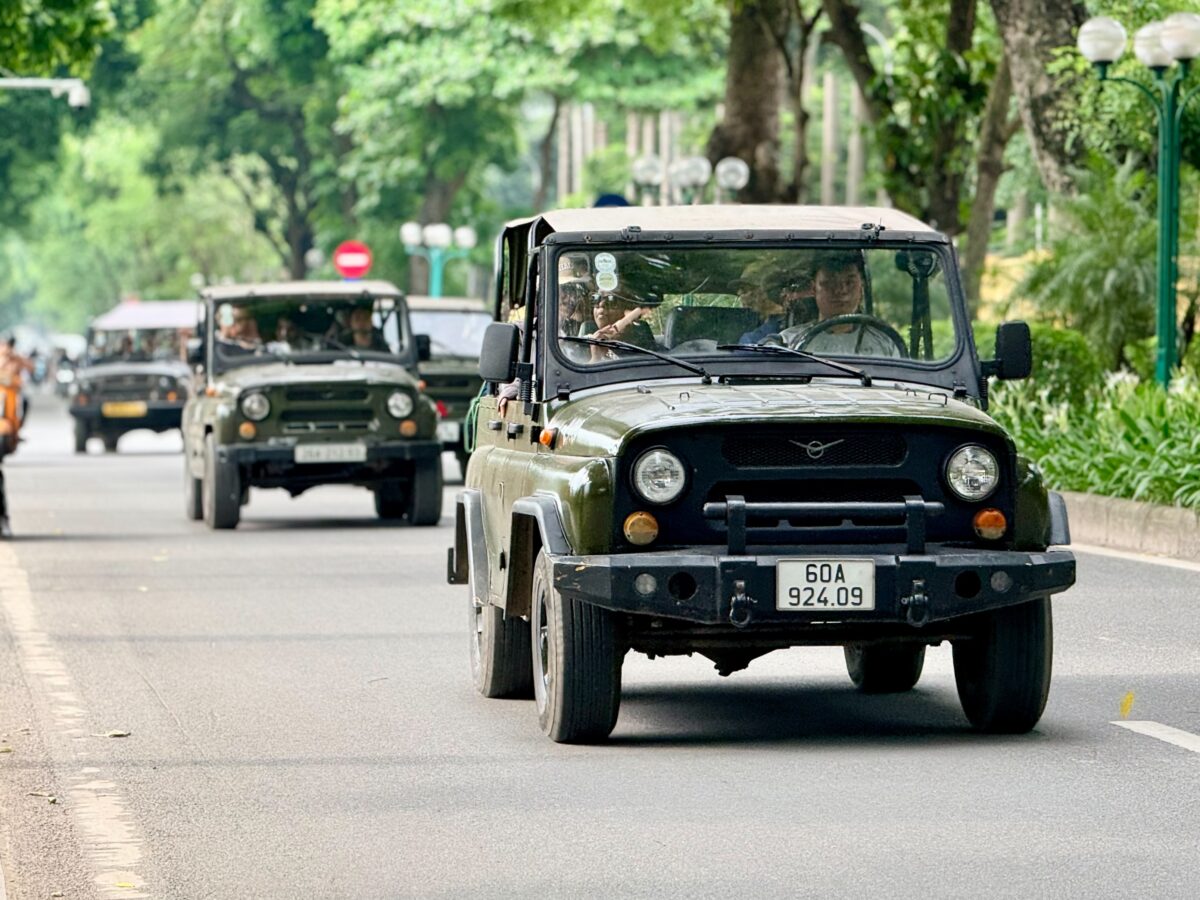
A Hanoi Jeep Tour is a sightseeing experience conducted in an open-air Vietnam Army-style Jeep with a professional driver and guide.
You are a passenger rather than the person driving the Jeep, so there is no special driving skill required. The current city tour is suitable for travelers of different ages and experience levels.
The experience combines transportation and sightseeing. Instead of arriving at one attraction, getting out, taking photographs, and returning to a conventional vehicle, you spend much of the journey moving through Hanoi’s streets and observing life from the Jeep.
That makes the journey between attractions part of the experience.
Your First Impression of Hanoi From the Jeep
One of the first things you notice is the rhythm of Hanoi.
Scooters move around cars and buses. Vendors arrange food beside the pavement. Small cafés open directly onto the street. Houses rise vertically because land in the central districts is limited. Old buildings stand beside modern developments.
From inside a closed tourist bus, much of this activity feels distant.
From an open-air Jeep, it feels much closer.
You can hear the city, see people going about their routines, and notice details that would otherwise pass behind a window.
Where Does the Tour Usually Start?
For the current city Jeep experience, travelers staying in Hanoi’s Old Quarter can receive hotel pickup and drop-off. A central meeting point can also be arranged when appropriate.
The guide normally meets you before departure, explains the basic route, and gives a short safety briefing.
Then the Jeep moves into the streets of Hanoi.
This is an advantage for first-time visitors because you do not have to figure out transportation to several different attractions yourself.
How Long Does a Hanoi Jeep Tour Take?
The standard city experience is approximately 4 to 4.5 hours, depending on the selected itinerary.
Current departure options include a morning tour from approximately 8:00 AM to 12:30 PM, an afternoon tour from 1:00 PM to 5:30 PM, and an evening experience from 5:30 PM to 9:30 PM. Meals are arranged according to the departure period.
For a first visit, four hours is long enough to experience several different areas without turning your entire day into one sightseeing activity.
What Will You See?
The exact route depends on the tour you select, but a typical city experience can combine historic Hanoi, political landmarks, residential areas, lakes, the Red River, local markets, and food.
The important thing is that the route does not treat Hanoi as one single neighborhood.
You move between different environments, and that contrast is what makes the experience interesting.
Exploring the Old Quarter
The Old Quarter is the obvious place to begin understanding Hanoi.
Its narrow streets are associated with historic guild streets, traditional businesses, restaurants, cafés, street vendors, and dense residential life.
But rather than spending the entire tour inside the Old Quarter, the Jeep uses it as one chapter of a larger journey.
You can see the difference between the commercial center and quieter residential streets as the route continues outward.
Seeing the French Quarter
The French Quarter offers a completely different visual identity.
Wide streets, colonial-era buildings, mature trees, government buildings, hotels, and the Hanoi Opera House create a more spacious environment than the narrow lanes of the Old Quarter.
Seeing both districts during the same Jeep experience helps first-time visitors understand why Hanoi can feel like several cities at once.
Hanoi Opera House
The Hanoi Opera House is one of the city’s most recognizable examples of French colonial architecture.
For first-time visitors, it provides an easy visual introduction to Hanoi’s architectural history.
A Jeep Tour does not require you to spend hours inside every attraction. Instead, the guide can explain the significance of the area while the route continues through the surrounding streets.
This keeps the experience moving while still giving you historical context.
Long Bien Bridge: More Than a Photo Stop
Long Bien Bridge is one of the most memorable parts of many Hanoi Jeep itineraries.
The bridge crosses the Red River and provides a completely different perspective from the dense streets of central Hanoi.
As you travel toward the river, the surroundings gradually change.
Buildings become less dominant.
The landscape opens.
You begin to see the relationship between Hanoi and the Red River.
For first-time visitors, this is one of the moments when Hanoi’s geography suddenly makes more sense.
Discovering the Red River Area
The Red River is an important part of Hanoi’s identity, but it is easy to overlook when you stay around Hoan Kiem Lake.
A Jeep allows the tour to move toward riverside areas without requiring a long walk.
The landscape can include gardens, farmland, narrow paths, river views, and communities that feel surprisingly distant from the center.
It is a reminder that Hanoi is not entirely urban.
Banana Island: Hanoi’s Unexpected Green Side
Banana Island is one of the most unusual experiences for travelers visiting Hanoi for the first time.
The area offers gardens, farmland, banana trees, and rural-looking paths within the broader metropolitan landscape.
Current Jeep itineraries specifically include Banana Island as a contrast to the busy city center.
For many visitors, this becomes one of the most unexpected photographs of their Hanoi trip.
West Lake and Truc Bach Lake
After the busy streets and Red River landscape, West Lake offers another change of atmosphere.
The lake is surrounded by residential areas, cafés, restaurants, temples, and quieter streets.
Truc Bach Lake nearby has its own history and character.
Because West Lake is extensive, seeing it by Jeep is more practical than attempting to walk around the entire area during a half-day city tour.
Ho Chi Minh Mausoleum Area
The Ba Dinh area introduces another side of Hanoi.
Here you find major political and historical landmarks, including the Ho Chi Minh Mausoleum, Presidential Palace, Ba Dinh Square, and nearby government buildings.
The environment is noticeably different from the Old Quarter.
The streets are broader, the architecture is more formal, and the atmosphere is quieter.
A guide can provide the historical context while the Jeep moves through the area.
Presidential Palace and French Architecture
The Presidential Palace is another example of Hanoi’s layered history.
Its French architectural style reflects a period when Hanoi was shaped heavily by European colonial influence.
Seeing it alongside Vietnamese historical landmarks helps first-time visitors understand the mixture of influences that have shaped the capital.
Train Street
Train Street is one of the most recognizable places associated with modern Hanoi travel.
Its unusual setting comes from railway tracks running directly through a densely settled neighborhood.
A responsible Jeep Tour should treat Train Street as a cultural and residential environment rather than simply a photography location.
Access conditions can change, so visitors should follow the guide’s instructions and remain in permitted areas.
The more interesting question is not simply “Can I take a photo here?”
It is “How did everyday life develop around this railway?”
Local Markets
Markets provide another window into Hanoi.
Instead of polished souvenir shops, you see ingredients and products being bought for everyday use.
Vegetables, herbs, fruit, meat, seafood, household products, snacks, and other goods create a much more ordinary picture of the city.
Current Jeep itineraries include local markets and lesser-known trading areas as part of the route.
For first-time visitors, these stops can be more revealing than another famous monument.
Hanoi’s Hidden Lanes
One of the strongest reasons to choose a Jeep Tour is the ability to leave the main roads.
The route can move through narrow lanes, residential areas, schools, small businesses, markets, and streets that most visitors would never intentionally seek out.
The Jeep does not simply take you to “hidden Hanoi.”
It allows you to travel through the everyday Hanoi that exists between the famous landmarks.
What Will You Eat?
Food is usually an important part of the experience.
Depending on the selected itinerary and departure time, food can include a local meal, street snacks, drinks, Vietnamese coffee, or dessert. Current city Jeep products state that food and drinks are included.
This is useful for first-time visitors because you do not have to research every restaurant before arriving.
You can simply ask your guide what you are eating, how it is traditionally served, and what ingredients are involved.
Vietnamese Egg Coffee
Egg Coffee is one of the classic Hanoi specialties that many first-time visitors want to try.
The drink combines strong Vietnamese coffee with a rich, creamy egg mixture.
It is often closer to a dessert than a conventional cup of coffee.
Current Jeep itineraries offer Vietnamese Egg Coffee or Mango and Caramel Pudding as a sweet ending to the experience.
Is the Food Authentic?
The goal of the food component is to introduce travelers to Vietnamese dishes in places selected by the tour operator.
But “authentic” does not necessarily mean that every dish is exotic or unfamiliar.
Some of the best first Hanoi food experiences are simple: a bowl of noodles, grilled pork, fresh herbs, Vietnamese coffee, or a small street snack.
The guide’s explanation can be just as important as the dish itself.
Morning, Afternoon, or Evening?
Your choice of departure time changes the character of the experience.
A morning Jeep Tour is ideal if you want cooler temperatures, active markets, and daylight photography.
An afternoon tour works well if you prefer a slower start to your day and want to see Hanoi transition from afternoon into the busier part of the city.
An evening Jeep Tour creates a completely different atmosphere. Streets become brighter, food stalls become more active, and the city takes on a stronger nightlife energy.
Current city Jeep schedules offer all three periods.
What Should First-Time Visitors Choose?
If you have just arrived in Hanoi, the morning or afternoon tour is particularly useful because you can use the experience to understand the city before exploring independently.
If food and atmosphere are more important to you, the evening option is attractive.
There is no universally best departure time.
The best choice depends on what you want your first impression of Hanoi to feel like.
Is a Hanoi Jeep Tour Safe?
Passengers do not drive the Jeep.
You travel with an experienced driver while a guide accompanies the group.
The current tours state that no previous experience is required and that the experience is suitable for all skill levels.
As with any road-based experience in Hanoi, travelers should remain seated as instructed and follow the driver’s and guide’s safety directions.
What Happens If It Rains?
Rain does not necessarily mean the tour has to be canceled.
The current Jeeps have retractable rooftops, and rain ponchos are provided. The operator states that tours run in rain or shine, although severe weather can require safety-related changes.
In Hanoi, a sudden shower can also change the atmosphere of the city dramatically.
Wet streets, reflections, umbrellas, and food stalls under covered sidewalks can create a very different visual experience.
What Should You Wear?
Comfortable clothing is the easiest choice.
Wear shoes that are suitable for getting in and out of the Jeep and walking around different stops.
For sunny days, sunglasses and sunscreen are useful.
During cooler months, particularly from December through February, a light jacket or long-sleeved layer can make the open-air ride more comfortable.
Is a Jeep Tour Suitable for Children?
Yes.
Children generally enjoy the novelty of the Jeep, while parents benefit from not having to walk between every destination.
The current city Jeep product lists children aged 5–11 at a separate rate and children under four as free.
For families with very young children, a private Jeep can also provide more flexibility around breaks and food.
Is It Good for Couples?
A Jeep Tour works particularly well for couples who want something more memorable than a standard sightseeing bus.
You can share food, take photographs, explore unfamiliar streets, and experience Hanoi from an open-air vehicle.
An evening tour can be especially atmospheric.
What About Older Travelers?
The Jeep format reduces the amount of continuous walking required.
You still get out at selected locations, but you are not walking several kilometers between every attraction.
For travelers who prefer a slower physical pace, a private itinerary can be even more comfortable because the timing can be discussed in advance.
Group or Private Jeep Tour?
A group tour is ideal if you enjoy meeting other travelers and want a more economical experience.
A private tour makes more sense if you want the itinerary to revolve around your own group.
Current published pricing varies by group size. The standard city Jeep product lists small-group pricing from US$50 per adult, while private rates vary according to the number of travelers.
Rates can change, so travelers should confirm the current price when booking.
How Much Does a Hanoi Jeep Tour Cost?
Current published prices for the main city Jeep experience are approximately US$50 per adult for the small-group tour.
Private pricing is currently listed at approximately US$70 per person for two travelers, US$60 for three, US$55 for four, and US$50 for groups of five or more.
Other Jeep experiences have different prices depending on duration and destination.
For example, current listings show a shorter 2.5-hour Jeep experience and full-day countryside options.
What Is Usually Included?
The exact inclusions depend on the product, but the standard city experience currently includes transportation by Jeep, an English-speaking guide, food or meals according to departure time, drinks, and Old Quarter pickup and drop-off.
Rain protection is also provided.
Before booking, always check the specific itinerary because a four-hour city tour and an eight-hour countryside experience will naturally have different inclusions.
How Far in Advance Should You Book?
First-time visitors do not normally need to reserve a Jeep Tour months ahead.
For a normal weekday, 3–7 days ahead is a comfortable timeframe.
If you want a private Jeep, are traveling with a larger group, want a particular evening departure, or are visiting during a busy holiday period, booking one to two weeks ahead is safer.
The current operator accepts direct bookings by WhatsApp and email and states that the reservation is confirmed once the team replies.
Should You Book Before Arriving in Hanoi?
If the Jeep Tour is an important part of your itinerary, booking before arrival is convenient.
You can provide your hotel, preferred departure time, number of travelers, and dietary requirements in advance.
If your schedule is flexible, you can also arrange the tour after arriving in Hanoi.
The important thing is to receive confirmation before assuming your tour is secured.
How Is a Jeep Tour Different From a Walking Tour?
A walking tour allows you to move slowly through a small area.
That is excellent for the Old Quarter.
A Jeep Tour covers a much larger geographical area.
You can begin in the historic center, travel toward the Red River, visit Long Bien Bridge, continue through Banana Island, reach West Lake, and return toward central Hanoi.
The choice is not really about which format is “better.”
It is about whether you want depth in one neighborhood or breadth across Hanoi.
How Is It Different From a Food Tour?
A Food Tour makes cuisine the central focus.
A Jeep Tour treats food as one part of a wider Hanoi experience.
If your priority is trying as many dishes as possible, a dedicated Food Tour may be better.
If you want food plus landmarks, neighborhoods, history, scenery, and transportation through the city, the Jeep format provides a broader introduction.
A Jeep Food Tour sits between the two.
Why a Local Guide Matters
A first-time visitor can see Hanoi independently.
What is harder is understanding what you are seeing.
Why are houses so narrow?
Why are so many businesses located on the ground floor of homes?
Why do people eat on tiny stools?
Why does one street specialize in one type of product?
Why is the Red River so important?
Why did Hanoi develop around these particular neighborhoods?
A local guide gives these scenes meaning.
That context is one of the most valuable parts of the tour.
Why Choose a Women-Led Jeep Experience?
A women-led tour offers another way to experience Hanoi.
Local female guides can introduce the city through personal knowledge of its food, neighborhoods, history, family traditions, and everyday routines.
The tours are not limited to female travelers.
Couples, families, solo travelers, and mixed groups can all participate.
The current Hanoi Jeep operation specifically presents its city tours as women-led experiences with professional female guides and experienced drivers.
What Makes the Jeep Itself Special?
The vehicle is part of the experience.
The open-air Vietnam People’s Army-style Jeep gives you a very different perspective from a modern coach.
You feel the air.
You hear Hanoi’s traffic.
You can look directly toward the sidewalks.
You see the city at eye level.
It makes the journey feel more like an adventure than simple transportation.
Is a Jeep Tour Worth It for a Short Hanoi Stay?
Definitely.
If you only have two or three days in Hanoi, a Jeep Tour can be a smart way to get an overview quickly.
Instead of spending your first day figuring out the geography of the city, the tour introduces you to several major areas in one experience.
Then you can return independently to the places that caught your attention.
What If You Have a Full Week?
If you have more time, use the Jeep Tour as an introduction rather than your entire Hanoi sightseeing plan.
You can spend one day discovering the city by Jeep, another walking around the Old Quarter, another exploring cafés and food, and another visiting areas outside the center.
For travelers with more time, there are also full-day Jeep experiences extending toward Co Loa and Bat Trang Ceramic Village. Current full-day itineraries run for approximately eight hours.
A Simple First-Timer’s Strategy
If I were planning Hanoi for a first-time visitor, I would use the Jeep Tour early in the trip.
Take the tour on your first or second day.
Let the guide introduce you to the city’s geography.
Pay attention to neighborhoods you like.
Ask about dishes you want to try again.
Notice cafés, markets, streets, and landmarks you want to revisit.
Then spend the rest of your Hanoi stay exploring those discoveries at your own pace.
That makes the Jeep Tour much more useful than simply treating it as another item on a checklist.
Final Verdict
A Hanoi Jeep Tour is one of the easiest ways for first-time visitors to understand the capital quickly.
You are not limited to the Old Quarter.
You can see historic Hanoi, French colonial architecture, Long Bien Bridge, the Red River, Banana Island, West Lake, Train Street, local markets, major historical landmarks, and everyday neighborhoods within one experience.
You also get something a conventional sightseeing itinerary cannot provide as easily: the feeling of moving through Hanoi rather than simply arriving at attractions.
For a first visit, that is the real advantage.
See the landmarks. Taste the food. Watch the neighborhoods change. Follow the Red River. Discover the quieter corners. And let a local guide explain the Hanoi that exists between the famous places.
Hanoi Jeep Tours – Led by Women
Address: 91 Tho Nhuom Street, Hoan Kiem District, Hanoi, Vietnam
WhatsApp: +84 982 416 518 / +84 981 090 989
Email: toursjeephanoi@gmail.com
Website: Hanoi Jeep Tours – Official Website