
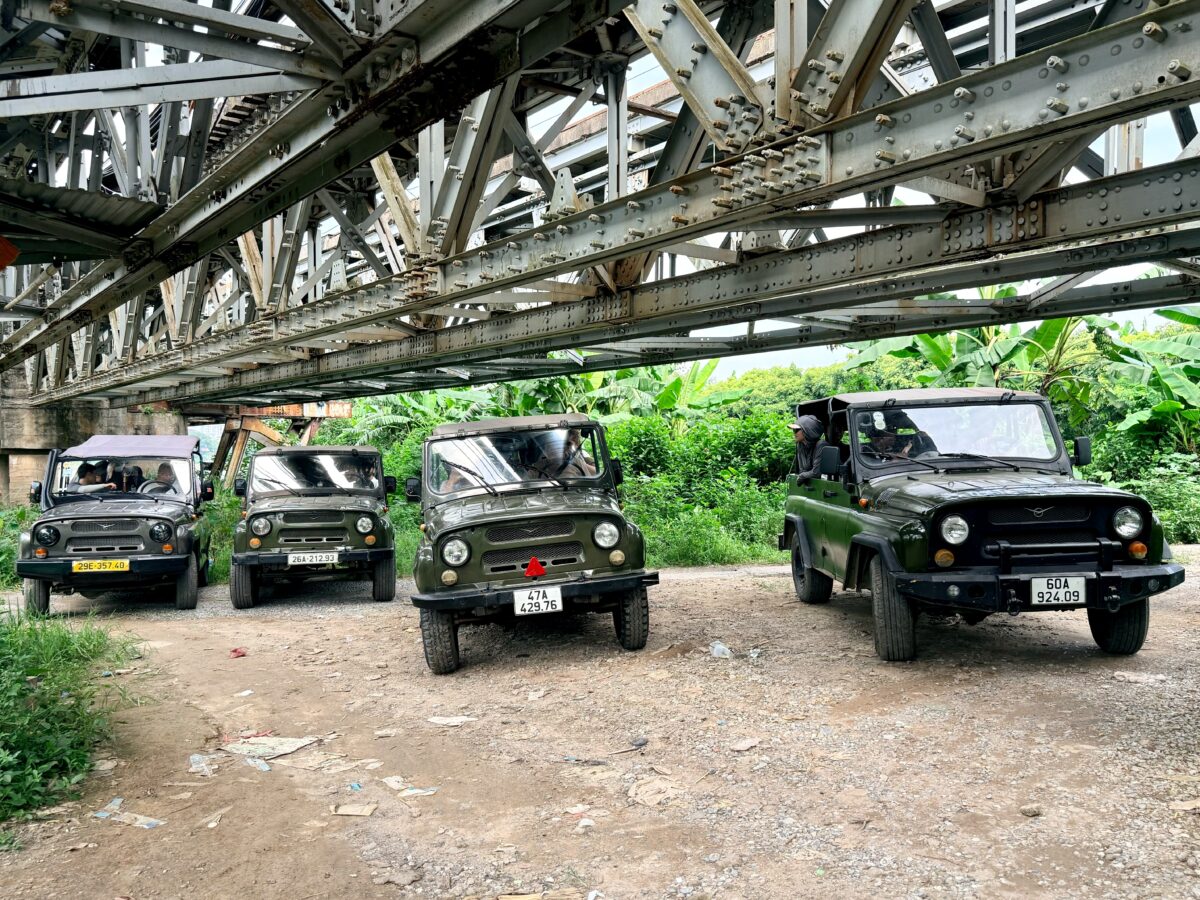
Hanoi Jeep Tour Around Hanoi’s Historic Neighborhoods
Hanoi is a city where history does not sit quietly behind museum doors. It appears in the shape of an old house, the name of a street, a century-old bridge, a French villa hidden behind trees, a railway passing through a residential neighborhood, or a family business that has occupied the same street for generations.
That is why exploring Hanoi by Jeep can feel very different from following a conventional sightseeing route.
Rather than visiting one monument after another, a Jeep Tour allows you to connect Hanoi’s historic neighborhoods and see how different periods of the city exist side by side. The current Hanoi Jeep route combines the Old Quarter, French Quarter, Ba Dinh area, Long Bien Bridge, Red River, Banana Island, West Lake, Train Street, local markets, and other less-visited streets.
Hanoi’s History Is Spread Across Different Neighborhoods
The first thing to understand about Hanoi is that its history is not concentrated in one district.
The Old Quarter represents centuries of commerce and traditional urban life. The French Quarter introduces another architectural layer. Ba Dinh connects visitors with modern Vietnamese history and national landmarks. Around Long Bien, the Red River reveals another side of the city’s development, while West Lake has a quieter residential and cultural atmosphere.
Traveling between these areas makes the history easier to understand because you can see the physical changes with your own eyes.
Starting in the Old Quarter
The Old Quarter is usually the natural starting point for discovering historic Hanoi.
Its streets are narrow, busy, and densely packed with homes, shops, cafés, restaurants, temples, and small businesses. The traditional street names reflect the area’s historic craft and trading communities.
A Jeep gives you the opportunity to see this environment without spending the entire day walking.
You can move through the busy streets, observe the architecture, and listen to your guide explain how the district developed before continuing toward other parts of Hanoi.
From Ancient Streets to the French Quarter
One of the most interesting transitions happens when the Jeep leaves the Old Quarter and enters the French Quarter.
The streets become wider.
Buildings become more formal.
Trees and colonial-era architecture create a noticeably different atmosphere.
The Hanoi Opera House is one of the most recognizable landmarks in this part of the city, and its architecture provides a visual reminder of the French influence on Hanoi.
Seeing the Old Quarter and French Quarter in one journey makes the contrast particularly clear. Current Jeep routes include both districts as part of their city exploration.
Hanoi Opera House and the Historic City Center
The Hanoi Opera House is more than a photography stop.
Its presence helps explain how Hanoi developed into an important administrative and cultural center during the colonial period.
The surrounding streets also contain grand buildings, hotels, government offices, and older residential structures.
A local guide can place these buildings within the wider story of Hanoi rather than treating them as isolated architectural attractions.
Moving Toward Ba Dinh
The journey from the central districts toward Ba Dinh reveals another transformation.
The streets become more spacious and the architecture increasingly formal.
This is the area associated with some of Vietnam’s most significant national landmarks, including Ba Dinh Square, the Ho Chi Minh Mausoleum, the Presidential Palace, and the National Assembly area.
The atmosphere here contrasts sharply with the commercial energy of the Old Quarter.
Ho Chi Minh Mausoleum Area
The Ho Chi Minh Mausoleum complex is one of the most important historical areas in Hanoi.
For visitors, the significance of the area goes beyond the building itself.
Ba Dinh Square is closely associated with major moments in modern Vietnamese history, making this part of the city an important stop for understanding Vietnam in the 20th century.
A Jeep tour allows you to travel through the district while your guide provides context about the landmarks around you.
The Presidential Palace
Nearby, the Presidential Palace provides another example of Hanoi’s architectural layers.
Its European-style design contrasts with traditional Vietnamese buildings found elsewhere in the city.
This mixture is one of the defining characteristics of Hanoi: different periods have not replaced one another completely. Instead, they remain visible beside each other.
Hanoi Flag Tower
The Hanoi Flag Tower is another historic landmark along the city’s central route.
Standing within the wider Ba Dinh area, it represents an older layer of Hanoi’s military and administrative history.
From a Jeep, you can see the relationship between the tower and the surrounding modern city rather than experiencing it as an isolated monument.
From the City to Long Bien Bridge
One of the most dramatic changes occurs when the Jeep heads toward Long Bien Bridge.
The dense central streets gradually give way to the Red River landscape.
Long Bien Bridge itself is one of Hanoi’s most recognizable historic structures. Current Jeep itineraries include the bridge as a major part of their city route and highlight its historical importance and views over the Red River.
For first-time visitors, crossing or approaching the bridge can feel like entering another chapter of Hanoi’s story.
Long Bien Bridge and the Colonial Era
Built during the French colonial period, Long Bien Bridge became an important transportation connection across the Red River.
Over time, it has witnessed enormous changes in Hanoi.
Today, the bridge remains a functioning part of the city’s transport network while also serving as a powerful historical symbol.
The best part of seeing it by Jeep is that you do not only see the bridge.
You see the river, surrounding communities, railway infrastructure, farmland, and the changing skyline.
The Red River Side of Hanoi
The Red River is fundamental to understanding Hanoi’s geography.
Yet visitors who remain around Hoan Kiem Lake can easily forget that a major river lies just beyond the central districts.
A Jeep Tour can take you toward the river and reveal a less polished but often more fascinating side of the capital.
Gardens, farms, narrow paths, riverside communities, and traditional activities exist surprisingly close to the city center.
Banana Island: Historic Hanoi Meets Rural Life
Banana Island is one of the most unexpected parts of a Hanoi Jeep itinerary.
The landscape includes gardens, banana trees, farmland, and quieter paths.
It feels almost rural despite being within the metropolitan area.
Current Jeep routes specifically include Banana Island as a green contrast to Hanoi’s dense urban neighborhoods.
For travelers interested in understanding how Hanoi developed around the Red River, this section of the journey is particularly valuable.
Discovering Hanoi’s Residential Streets
The most interesting historic neighborhoods are not always the ones with monuments.
Some are ordinary residential streets where old houses stand beside newer buildings.
You may see residents preparing food, children returning from school, small workshops, neighborhood cafés, or families using the ground floor of their homes as businesses.
This everyday environment provides a more complete picture of Hanoi than landmarks alone.
Hidden Alleys and Old Homes
A Jeep Tour can also venture into smaller streets and hidden corners that are easy to overlook.
Current routes emphasize secret alleys, local homes, schools, markets, and lesser-known trading areas.
These places show how Hanoi’s historic neighborhoods continue to function as living communities.
The city is not an open-air museum.
People still live, work, eat, shop, and socialize in these spaces every day.
The B-52 Wreckage at Huu Tiep Lake
Another unusual historical stop can be found around Huu Tiep Lake in Ngoc Ha.
The remains of a B-52 aircraft are preserved in the lake, creating a striking connection between Hanoi’s modern history and its everyday residential environment.
What makes the location especially memorable is its setting.
The historical remains are surrounded by ordinary neighborhood life.
A guide can explain the historical background while helping visitors understand why the site remains significant.
Current Hanoi Jeep routes include the B-52 area among their historical and cultural highlights.
Ngoc Ha and the Flower Village Area
Ngoc Ha is another neighborhood where Hanoi’s past and present overlap.
The area is associated with traditional gardening and flower cultivation while also being surrounded by dense urban development.
Walking or driving through these streets gives you a glimpse of how specialized communities have survived as Hanoi has expanded around them.
This kind of neighborhood is exactly why a local guide can add value.
Without explanation, you might simply see another narrow street.
With context, you begin to understand what makes the area special.
West Lake: A Different Chapter of Hanoi
After exploring historic central districts, the Jeep can move toward West Lake.
The atmosphere changes immediately.
The lake is expansive, the roads are generally wider, and the surrounding neighborhoods contain cafés, restaurants, villas, temples, residences, and embassies.
West Lake is also one of the places where Hanoi’s contemporary lifestyle is particularly visible.
Old traditions and modern cafés exist almost next to each other.
Truc Bach Lake
Truc Bach Lake sits beside West Lake and has its own distinctive character.
The surrounding streets are closely connected with Hanoi’s food culture and residential life.
From the Jeep, the area provides another example of how Hanoi’s lakes shape the city’s neighborhoods.
Rather than being simply scenic landmarks, the lakes are part of how people move, work, eat, and relax.
Tran Quoc Pagoda
Near West Lake, Tran Quoc Pagoda introduces a much older spiritual dimension to the city.
Its setting beside the water makes it one of Hanoi’s most recognizable religious landmarks.
For travelers interested in history, visiting or passing through this area helps demonstrate that Hanoi’s development has always involved more than politics and commerce.
Religion, architecture, water, and community life are deeply connected.
Train Street and the Railway Neighborhood
Train Street represents a completely different kind of historic urban landscape.
Here, railway infrastructure passes through a densely inhabited neighborhood.
The narrow space between homes and tracks has become one of Hanoi’s most photographed environments.
But the more meaningful way to experience it is to understand the neighborhood itself.
It is a residential community first and a tourist attraction second.
Current Jeep itineraries include Train Street, while responsible tours should follow current access restrictions and safety instructions around the railway.
Historic Neighborhoods Through Food
Hanoi’s food culture is inseparable from its neighborhoods.
Different streets and districts have developed their own culinary identities.
A local market may reveal ingredients used by families every day.
A small restaurant may have been serving the same dish for decades.
A sidewalk café may offer an entirely different experience from a modern coffee shop.
Current Jeep tours incorporate local meals and Vietnamese Egg Coffee or other desserts into the experience.
This means the historical journey does not have to stop when it is time to eat.
Food becomes another way of understanding the city.
A Taste of Hanoi’s Street Life
Street food is particularly interesting when viewed in its neighborhood context.
Bún Chả, Bánh Cuốn, Phở, grilled dishes, Vietnamese coffee, and other specialties are not simply foods on a menu.
They are part of everyday routines.
People eat breakfast before work.
Families gather for lunch.
Friends meet at cafés.
Vendors prepare food directly beside the street.
A Jeep Tour can connect these food traditions with the places where they are part of daily life.
Why the Jeep Is Ideal for Historic Neighborhoods
Walking is excellent for exploring one neighborhood in depth.
The problem is that Hanoi’s historic districts are spread across a relatively large area.
A Jeep solves that problem.
You can spend time in the Old Quarter, then move toward the French Quarter, Ba Dinh, Long Bien, the Red River, Banana Island, and West Lake without losing hours walking between them.
The vehicle becomes a bridge between different periods of Hanoi’s history.
The Open-Air Experience
There is another reason the Jeep format works particularly well for historic neighborhoods.
You are not separated from the streets by a large window.
You can hear conversations, traffic, market sounds, and street vendors.
You can smell food cooking.
You can see architectural details from the side of the road.
You can photograph without shooting through a bus window.
The city feels immediate.
What Is the Best Time to Explore Historic Hanoi?
Morning offers a quieter atmosphere in some areas and excellent conditions for seeing markets and everyday routines.
Afternoon provides stronger contrasts between busy streets and quieter neighborhoods.
Evening changes the personality of central Hanoi completely.
Current city Jeep tours offer morning departures around 8:00 AM, afternoon departures around 1:00 PM, and evening departures around 5:30 PM.
For historical architecture and photography, morning or afternoon can be particularly rewarding.
For street life and food, evening is difficult to beat.
How Long Do You Need?
A typical city Jeep experience takes approximately four to four and a half hours.
That is enough time to connect several historic neighborhoods without making the experience feel like an exhausting full-day sightseeing marathon.
For travelers who want a deeper historical journey beyond central Hanoi, longer itineraries are available.
A current full-day Jeep route to Co Loa and Bat Trang lasts approximately eight hours and extends the experience into Hanoi’s surrounding historical and craft communities.
Historic Hanoi for First-Time Visitors
If you have never visited Hanoi before, this type of Jeep itinerary provides something particularly valuable: orientation.
You learn where the Old Quarter ends.
You see where the French Quarter begins.
You understand the location of Ba Dinh.
You discover how Long Bien connects the city with the Red River.
You see how West Lake relates to the central districts.
By the end, Hanoi feels less like a collection of disconnected attractions.
It becomes a city with a recognizable structure.
Historic Hanoi for Returning Visitors
For returning travelers, a neighborhood-focused Jeep Tour can be even more interesting.
You may already have seen Hoan Kiem Lake, the Old Quarter, and the major monuments.
Instead of repeating the same itinerary, you can explore smaller streets, markets, residential communities, riverside areas, and lesser-known historical sites.
The experience becomes less about ticking off landmarks and more about seeing how Hanoi continues to evolve.
A Good Option for Couples
Historic neighborhoods provide plenty of opportunities for couples to combine sightseeing with food and photography.
A private Jeep allows you to move at a comfortable pace, stop for photographs, and spend more time in areas that interest you.
An evening route can add illuminated streets, lakeside views, local dinner, and Hanoi’s nighttime atmosphere.
A Good Option for Families
Families can also benefit from the Jeep format because it reduces the amount of walking required between neighborhoods.
Children can experience the novelty of the open-air vehicle while parents learn about Hanoi’s history.
The mixture of landmarks, markets, food, bridges, lakes, and unusual neighborhoods also creates more variety than a museum-heavy itinerary.
What Should You Wear?
Comfortable clothes and shoes are best.
The Jeep is open-air, so sunglasses and sunscreen are useful during daytime tours.
A light jacket or long-sleeved layer is helpful during Hanoi’s cooler winter months.
If rain is expected, the current Jeep operation provides rain ponchos and uses vehicles with retractable rooftops.
Is a Historic Neighborhood Jeep Tour Safe?
Passengers do not drive the vehicle.
The tour is conducted with an experienced driver and guide, and travelers are given safety instructions before departure.
When visiting areas around active railway tracks, including Train Street, visitors should follow the guide’s instructions and remain in authorized areas.
The objective is to experience Hanoi responsibly rather than take unnecessary risks for photographs.
Why Choose a Local Women-Led Jeep Tour?
A neighborhood tour becomes more personal when the guide knows the city beyond its official history.
Local female guides can share stories about food, family life, neighborhoods, traditions, and the changes they have witnessed in Hanoi.
The experience is not limited to women travelers. Couples, families, solo travelers, and mixed groups can all join.
The current Hanoi Jeep operation specifically presents its tours as women-led experiences with professional female guides and experienced drivers.
Historic Hanoi Is Best Experienced as a Story
The Old Quarter tells one story.
The French Quarter tells another.
Ba Dinh reveals modern national history.
Long Bien connects Hanoi with the Red River.
Banana Island shows the city’s agricultural side.
West Lake introduces a slower lakeside atmosphere.
Train Street demonstrates the unusual relationship between infrastructure and residential life.
None of these places explains Hanoi by itself.
Together, they tell a much bigger story.
Final Thoughts
A Hanoi Jeep Tour Around the City’s Historic Neighborhoods is not simply a faster way to visit landmarks.
It is a way to understand how Hanoi has grown.
You move from narrow merchant streets to French colonial avenues, from political landmarks to riverside communities, from historic bridges to green farmland, and from old neighborhoods to modern lakeside districts.
Along the way, you see that Hanoi’s history is still part of everyday life.
People still live in old neighborhoods.
Markets still operate beside historic streets.
Traditional foods remain part of daily routines.
The Red River still shapes the city’s landscape.
And buildings from different periods continue to stand beside one another.
That is what makes exploring Hanoi by Jeep so memorable.
You are not simply traveling through Hanoi’s history. You are traveling through neighborhoods where that history is still alive.
Hanoi Jeep Tours – Led by Women
Address: 91 Tho Nhuom Street, Hoan Kiem District, Hanoi, Vietnam
WhatsApp: +84 982 416 518 / +84 981 090 989
Email: toursjeephanoi@gmail.com
Website: Hanoi Jeep Tours – Official Website
Current city Jeep tours run for approximately 4.5 hours, with morning, afternoon, and evening departures, and include Old Quarter pickup/drop-off, food or meals according to the departure, drinks, and an English-speaking guide.